Meta Description Best Practices: When Google Uses Yours vs. Generates Its Own
- November 15, 2026
- SEO
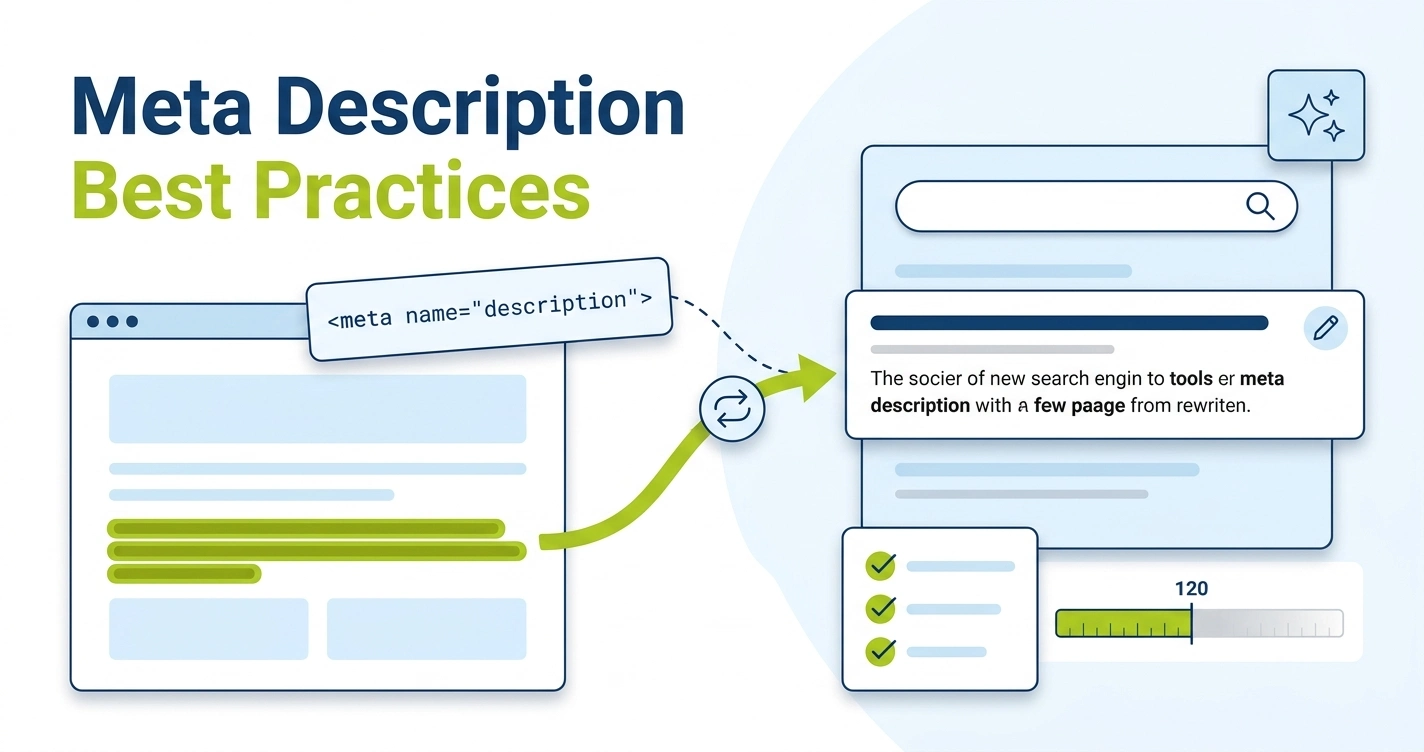
Google uses your meta description only when that text describes the page better than the page content itself for a specific search query. Otherwise, Google builds its own snippet dynamically from your page copy to match the user's intent.
Understanding when Google uses your meta description is essential for optimizing click-through rates without wasting time trying to force search engines to display your exact tags.
While you cannot completely stop Google from rewriting your snippets, you can significantly improve the chances of keeping your hand-written descriptions by aligning them closely with user search intent, keeping them unique, and ensuring they accurately summarize your page content.
If you need expert assistance with this balancing act, partnering with a reliable seo agency can help you focus your efforts where they matter most, on high-impact page copy and technical foundations that satisfy both human readers and search algorithms.
Does Google use your meta description or write its own?
Google does both.
It builds the snippet mainly from your page content and picks your meta description only when that text describes the page better than the page itself. That is the core of when Google uses your meta description.
Your description competes against your own page copy, not against other sites. If a paragraph on your page answers the search more exactly, that paragraph wins.
Google's snippet guide also says Google cannot manually change snippets for individual sites.
No support request will fix one, so better page copy and a clearer description are your only levers.
How Google builds a search snippet
Google builds the snippet from your page content first. The meta description comes second, and structured data is not a main source.
Google's guide was once read as if the tag came first, but a previous clarification noted that the old wording wrongly implied that structured data and the tag were the primary sources.
Google also builds each search snippet dynamically, so a single URL can show different text for different queries.
How often does Google rewrite meta descriptions?
Most of the time. Three studies put the rewrite rate well above half.
| Study | Sample | Year/device | Result |
| Ahrefs | 20,000 keywords | 2020, desktop | Google rewrote 62.78% |
| Search Engine Land | 30,000 keywords, brand terms removed | 2020, desktop and mobile | Rewritten 68% on desktop and 71% on mobile |
| Semrush | 10 random keywords, top 10 results | 2025, desktop and mobile | The supplied description, or a shortened version of it, was used about 28% of the time. |
The numbers differ because the studies used different keyword lists, devices, and years. Semrush also reports the share kept, not the share rewritten, and its sample is small.
Ahrefs split its data further. Google rewrote 59.65% of descriptions for fat-head keywords and 65.62% for long-tail keywords. It also found that 25.02% of top-ranking pages had no description at all, and that Google showed the written tag in 37.22% of snippets.
Rewriting is the normal state, not a fault on your site. Google treats other hints the same way, and it can ignore your canonical tag when other signals disagree.
Why Google rewrites your meta description
Google rewrites your description when other text better matches the search. These are the common triggers, each with a fix.
- It does not match the query.
Fix: write it around the main question the page answers, which is the search intent behind the query. - It is a string of keywords. Google says keyword lists are less likely to show.
Fix: write one or two plain sentences. - It repeats across pages. Google says identical descriptions do not help.
Fix: write a unique one for each page that matters. Near-duplicate city pages are the usual culprit, as our guide to location page keyword cannibalization explains. - It is too short to say anything. Google's own weak example is "Mechanical pencil."
Fix: add who the page is for and one detail. - It is stale.
Fix: review the description whenever you change the page. - A passage answers the query more exactly.
Fix: let it. A strong passage is a win, so keep it in clear text near the top. - There is no description tag at all.
Fix: add one to every page that matters. - The page lacks the words people search.
Search Engine Journal's report on Google's John Mueller gives a case. A large retailer's home page never used the words "home page" in its visible text, only in image alt text, so Google pulled odd text.
Fix: use the plain words people search in your visible copy, and keep image alt text descriptive but secondary.
Technical faults that hide your tag from Google
Sometimes Google cannot read your tag at all.
Four faults cause this:
- Tag outside the head: Google may ignore it in the body.
- JavaScript rewriting the tag: A script changes the text after the page loads.
- Broken markup: A missing quote breaks the tag.
- Duplicate tags: Two tags send mixed signals.
To confirm, run the URL Inspection tool in Search Console and read the HTML Googlebot received. For a site-wide check, a website auditing checklist catches duplicate tags across templates.
A site: search for the URL shows the snippet Google serves today.
Why your homepage snippet looks random
A homepage with no clear descriptive sentence gives Google nothing to pull from.
In one Google Community thread, a store owner's description looked correct in Shopify, yet Google showed a random Dutch disclaimer for about three weeks.
Reindexing did not help, and the reply said that Google shows whatever it deems useful for the search.
Add one plain sentence with your brand name to the visible copy, describing what you do in words a visitor would use.
If a footer disclaimer keeps winning, data-nosnippet can exclude it. This also answers why your meta description is not showing in Google: the page usually gave Google a better option.
Why one page shows different descriptions for different searches
Google builds snippets per query, not per page. Google builds snippets for individual queries rather than assigning one fixed description to a page.
Seer Interactive’s April 2025 rank-tracking analysis, published in May 2025, found that individual pages displayed between 2 and 11 different snippets in a single month; however, this is proprietary agency data and results may vary by site and query set.
A page that ranks for 40 queries, many of them long-tail or zero-volume keywords, will not show one fixed description for all 40. Pick the main question the page answers and write for that one.
Device and location can also change the text. A phone fits fewer characters than a desktop, and the same search from two places can pull different passages.
When Google keeps the description you wrote
Google keeps your description when it describes the page better than the page copy does for that search. Five checks improve the odds:
- It is unique to the page.
- It reads like a description, not a keyword list.
- It covers what the page contains.
- It uses words that appear on the page and match the search. Google bolds those words in the result.
- It fits the space on the screen.
Practitioners also report that commercial and landing pages with product-specific descriptions stay more often.
Treat that as an observation, not a study.
How to write a meta description Google will keep
Cover what the page is about, who it is for, and what the reader gets. Write it like a short pitch to someone deciding whether to click. It does not have to be a full sentence.
Google’s guidance says that details such as price, author, and length can work well in a meta description because they bring scattered facts from a page together; hours and location are separately relevant to local-business listings.
Here is an example for a made-up page:
- Before: SEO tips, SEO guide, best SEO, SEO help, learn SEO.
- After: A step-by-step SEO checklist for small online stores. Covers product pages, site speed, and Search Console, with a template to copy.
Pro Tip: If you manage hundreds of pages, an on-page SEO service can write titles and descriptions page by page, starting with the pages that earn revenue.
Programmatic descriptions for large sites
Large sites cannot hand-write every description. Google says programmatic descriptions are acceptable, even encouraged, for database-driven sites if they are readable and varied.
Page-specific data, such as product name, price, and brand, makes a good base.
Meta descriptions and AI Overviews: what actually matters
The text of your meta description does not decide whether you appear in AI Overviews. Snippet eligibility does.
Google's AI features guide says a page needs to be indexed and eligible to show in Search with a snippet, and that no additional technical requirements apply.
That creates a risk.
Using the nosnippet tag stops Google from using your content as a direct input for AI Overviews and AI Mode. Setting a very low max-snippet value similarly limits the text Google can use, and max-snippet:0 functions the same way as nosnippet.
Search Console includes a Search generative AI control that manages your visibility across AI Overviews, AI Mode, and generative features in Discover.
Sites that opt out of this control stop receiving traffic and impressions from those features, though Google notes that using the control is not a ranking signal for regular search results.
AI Overviews and AI Mode often rely on query fan-out, where Google runs multiple related searches across subtopics and data sources to construct a single answer.
Because these background searches read your page content, the actual copy on your page remains what gets read and utilized.
Quick answer on how to stop Google rewriting meta descriptions: you cannot, except with nosnippet, which costs you the snippet and your AI eligibility.
Do meta descriptions help you get cited in AI search?
Meta descriptions do not directly influence whether your content gets cited in AI search results or AI overviews.
AI systems and search crawlers focus primarily on your actual page content, structured information, and main body copy to extract answers. While some SEO observations point to a general correlation between strong metadata and overall visibility, this relationship is indirect.
When AI models generate answers, they read the full text of your page rather than relying on summary tags.
Write meta descriptions to attract human readers who are deciding whether to click from traditional search results.
Do not spend valuable optimization hours trying to engineer your meta descriptions specifically for AI search engines. Focus that effort instead on creating comprehensive and authoritative page content.
Write descriptions for clicks, and do not budget GEO hours on them. Spend that time on page content and keyword research for AI Overviews.
And how AI crawlers find your best pages, which our guide to llms.txt for AI crawlers covers.
How long should a meta description be?
Google sets no length limit. Space is limited and depends on screen width, so Google cuts the text to fit the device.
Put what matters in the first 120 characters. One study of mobile results found that snippets peaked at 118 characters and dropped off after 121, according to Search Engine Journal's report.
Length does not decide whether Google keeps your text. Ahrefs found Google rewrote 61.46% of descriptions that were too long and 63.69% of the rest.
It also found that 40.61% of the 192,656 descriptions it studied were too long, so length is not what separates kept from rewritten.
The tags that control your snippet
Three tags let you control how much of your page Google can show.
- nosnippet: blocks the text snippet for the page.
- max-snippet:[number]: sets the maximum snippet length in characters.
- data-nosnippet: excludes one part of the page from snippets.
Heads up: all three can also limit which AI features are used. Add them on purpose, not by habit.
"Read more" deep links
A "Read more" deep link takes searchers to a specific section of your page. Google's guide lists three conditions that help it appear:
- Make the content visible right away, not hidden in an expandable section or tab.
- Do not use JavaScript to control the scroll position when the page loads.
- If you use history API calls or window.location.hash on load, keep the hash fragment in the URL.
How to check if Google is using your description
You can check in five steps and a few minutes.
- Search for the page's main query in a private window and find your result.
- View the page source and read the tag you wrote.
- Compare the two. If they match, Google used your tag.
- Repeat with three to five related queries because snippets change with each search.
- Open the URL Inspection tool in Search Console to confirm that Googlebot can see the tag.
Quick Tip: One practitioner on Reddit suggests checking the snippet if CTR drops while your position holds steady. A changed snippet is a common reason.
A note on FAQ schema and AI Overviews
FAQ schema does not get you into AI Overviews.
Google's AI guide asks that structured data match the visible text on the page, and visible Q&A under clear headings is what gets read.
Google also no longer shows the FAQ rich result in Search, according to its documentation updates page.
So write the questions and answers on the page for readers, and treat the markup as optional.
Where to spend your time instead
Write descriptions for pages with real impressions, especially branded and commercial queries. Leave programmatic descriptions on long-tail pages.
Search Engine Land removed descriptions from ten top articles for 15 days and saw virtually no change in rankings or clicks.
It was a small test, but it points the same way. For pages people share, still write one, because Ahrefs notes that social previews use the description when Open Graph tags are missing.
Then spend the hours on page copy. If you want a full-service SEO agency to handle that across a whole site, that is the work to hand over.
Final Word
Write one clear description for your top pages. Stop checking it every week, and stop burning valuable time trying to force Google to keep text it considers less relevant than your actual page content.
Instead, shift your focus to what Google prioritizes: clear, comprehensive page copy, well-structured content, and genuine value for the user. By prioritizing what matters on the page itself, you naturally improve your odds of earning organic clicks, satisfying search intent, and securing your place in both traditional search snippets and modern AI Overviews.
Ready to take your search visibility to the next level? Don't let meta description rewrites slow you down; focus your energy on crafting exceptional content and technical foundations that both readers and search engines love.
If you'd like a hand auditing your site's snippets, refining your page copy, or building a robust SEO strategy that drives real traffic, let's connect and get to work on your growth!
Frequently Asked Questions
Why is Googlebudg not showing my meta description?
Google shows your tag only when it describes the page better than your page text does for that search. Common causes are a query mismatch, a keyword list, a repeated, short or stale tag, a missing tag, or a technical fault. Use the URL Inspection tool to check what Googlebot received.
Are meta descriptions a ranking factor?
No. Ahrefs states that meta descriptions are not a ranking factor, but they can increase click-through rate. Google's guide describes the tag as a possible source for the snippet, not a ranking input.
Is there a character limit for meta descriptions?
Google sets no limit. It truncates the snippet to fit the device width. Put the key point in the first 120 characters; it is guidance, not a Google rule.
Do meta descriptions affect AI Overviews?
Not through the tag text. A page needs to be indexed and snippet-eligible to appear as a supporting link, and Google lists no additional requirements. A nosnippet tag removes that eligibility.
Should every page have a meta description?
Not necessarily. Google recommends prioritizing critical URLs, such as your home page and popular pages, if you lack time. Large sites can generate descriptions from page data.
Faisal Mustafa is an Online Market Specialist. He has been providing result oriented quality SEO services to clients worldwide successfully since 2008. He has hundreds of reviews and feedbacks on marketing forums. He is the admin of SEO viser team and a successful online marketer.
OUR SERVICES


Request a free quote
We offer professional SEO services that help websites increase their organic search score drastically in order to compete for the highest rankings even when it comes to highly competitive keywords.
More from our blog
See all posts