Google Maps Ranking Factors: 18 Signals That Move the Map Pack
- October 22, 2026
- Uncategorized
Google Maps ranking factors come down to three pillars that Google names itself. They are relevance, distance, and prominence. You cannot control distance, and nobody outside Google knows the exact weights. You can still improve the other two, and the 18 signals below show you how.
This blog uses Google's own documentation, the 2026 Whitespark local search ranking factors survey, and published tests from local SEO teams. It covers all 18 signals, the myths, the AI layer, a diagnostic checklist, and a clean way to track your results.
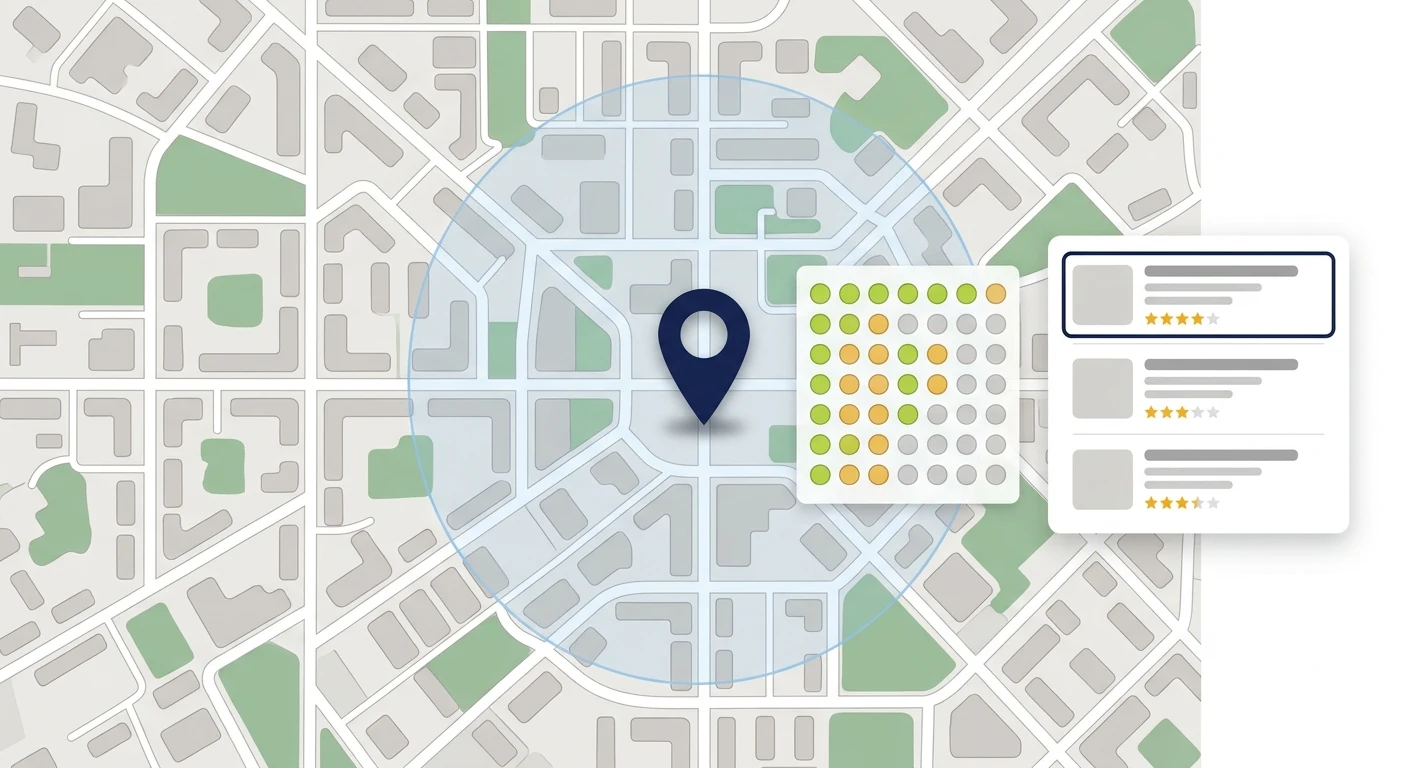
Here is what that looks like in practice. This is an illustrative example built from common local SEO patterns, not a client result. Suppose a roofing company in a mid-size city runs a 7x7 grid scan for "roof repair".
That grid has 49 points around the business. The profile uses "General contractor" as its primary category. The average rank across the grid is 14.2, and the business shows in the top 3 at only 6 of 49 points, which is about 12%.
Now, suppose the owner changes one thing. The primary category becomes "Roofing contractor", and nothing else changes. After four weeks, a second scan shows an average rank of 6.8.
The business now holds the top 3 at 21 of 49 points, which is about 43%. The biggest gains appear on the side of the grid farthest from the office. That pattern shows the old category was the bottleneck, not distance. Results like this vary by market, so always test your own grid.
The Quick Answer on How Google Ranks the Map Pack
Google ranks the Map Pack on relevance, distance, and prominence. Google says local results are based mainly on these three factors. It also says there is no way to request or pay for a better local ranking.
Here is what each pillar means in plain words.
- Relevance is how well your Google Business Profile (GBP) matches what the person searched for.
- Distance is how far your business is from the searcher, or from the area named in the search.
- Prominence is how well-known your business is. Google says this is based on how many websites link to your business and how many reviews you have. More reviews and positive ratings can help your local ranking.
There is a small freshness detail here. Google's current help page summary now says relevance, distance, and popularity. The section headings on the same page still say prominence. Both words point to the same idea.
Every one of the Google Business Profile ranking factors below fits one of these pillars. Real-time and behaviour signals sit on top of them.
These are the local pack ranking factors that matter most, and the table is the full map, so skim it first.
| # | Signal | Pillar | 2026 Local Pack Rank | One-Line Action |
| 1 | Primary GBP category | Relevance | #1 | Pick the most specific category for your main service. |
| 2 | Additional categories | Relevance | #8 | Add only categories that match real services. |
| 3 | Keywords in business name | Relevance | #3 | Use your real name only. Do not add keywords. |
| 4 | GBP services | Relevance | #22 (predefined), #30 (custom titles) | List every service you truly offer. |
| 5 | Profile completeness | Relevance | #16 | Fill every field and keep it current. |
| 6 | GBP landing page | Relevance | #17 (title tag), #20 (headings) | Match the page title and headings to the profile. |
| 7 | Geographic relevance of content | Relevance | #18 | Name your city, areas, and real local work. |
| 8 | Proximity to the searcher | Distance | #2 | Accept it, then win with other signals. |
| 9 | Physical address in the city of search | Distance | #4 | Target the city where your address sits. |
| 10 | Address visibility and pin accuracy | Distance | #7 (address shown), #10 (pin) | Show your address if you qualify and fix the pin. |
| 11 | Star rating | Prominence | #6 | Deliver good service and reply to every review. |
| 12 | Quantity of Google reviews with text | Prominence | #9 | Ask every customer for a written review. |
| 13 | Review recency and steady velocity | Prominence | #11, #14 | Collect reviews every week, not in bursts. |
| 14 | NAP consistency | Prominence | #15 | Match name, address, and phone everywhere. |
| 15 | Links to your GBP landing page | Prominence | #25 | Earn real local links to that page. |
| 16 | Branded search volume | Prominence | #23 | Build a name people search for. |
| 17 | Open at the time of search and accurate hours | Real-time | #5 (open now), #21 (hours) | Set exact hours and update holidays. |
| 18 | Click-through rate and engagement | Behaviour | #13 (CTR), #33 (engagement) | Make your listing worth clicking. |
Where This Evidence Comes From (and Its Limits)
No one outside Google can prove how Maps ranking works. So this blog uses three tiers of evidence and labels each one. That keeps the advice honest and easy to trust.
| Evidence Tier | Source | How Strong It Is |
| Tier 1 | Google's own statements and help pages | Official, but short on detail |
| Tier 2 | The 2026 Whitespark survey of 47 local search experts | Informed opinion, not proof |
| Tier 3 | Published tests run by local SEO teams | Real results, but small samples and no control group |
Be upfront about the limits. The Whitespark report says none of the experts have special access to the inner workings of Google's local algorithm. The rankings come from their analysis, research, and testing. Treat each rank as a strong hint, not a rule.
The survey also groups signals by weight for the Map Pack. According to the 2026 results, three groups matter most.
- GBP signals carry about 32%. This group covers categories, name, services, hours, and profile quality.
- Review signals carry about 20%. This group covers rating, count, recency, and review text.
- On-page signals carry about 15%. This group covers your website and the GBP landing page.
Review signals and behavioural signals gained the most weight in this edition. On-page and link signals slipped slightly. That shift is why this blog spends so much time on reviews and engagement. These group weights are third-party figures, so check the latest Whitespark report before you quote them.
Map Pack vs Local Organic Results (Different Rules)
A local search page shows two result types. The Map Pack is the box with three listings and a map. Local organic results are the normal blue links below it. They follow different rules, so one tactic can help one and do nothing for the other.
The primary category shows the gap best. In the 2026 survey it ranks #1 for the Map Pack and #85 for local organic results.
Here is how the weights differ.
| Factor | Map Pack | Local Organic |
| Biggest weight group | GBP signals (32%) | On-page signals (33%) |
| Review signals | 20% | 6% |
| Link signals | 8% | 24% |
| GBP signals | 32% | 7% |
| Primary category rank | #1 | #85 |
Map pack ranking factors lean heavily on the profile and reviews. Google local ranking factors for organic results lean on the website and links. The takeaway is simple. Optimize the GBP for the Map Pack.
Optimize the website for local organic results. Optimize the GBP landing page for both. These are third-party survey weights, and they may shift in the next edition.
Relevance Signals (How Well You Match the Search)
Relevance is the first group of Google Maps ranking factors you can fully control. It answers one question. Does your profile clearly match what the person typed? Seven signals decide this, and you control all of them. If you want to know how to rank higher on Google Maps, start here.
1. Primary GBP Category
Your primary category is the single biggest local search ranking factor in the 2026 survey. It ranks #1 for the Map Pack with a score of 227. Google uses it to decide which searches you belong to.
Pick the most specific category that matches your main service. Suppose you run a drain cleaning company. "Plumber" is broad, but a tighter category may match your best-paying searches better. Look at the primary categories used by the top three businesses in your area, then choose yours on purpose.
2. Additional Categories
Additional categories rank #8 for the Map Pack. They help Google show you for related searches. They work best when each one matches a service you really sell.
Add the ones you truly offer and stop there. A long list of loosely related categories can blur what you do. Review them twice a year, because Google adds and retires categories.
3. Keywords in the Business Name
Keywords in the GBP business title rank #3 for the Map Pack. That makes it one of the strongest signals in the survey. It is also the easiest one to abuse.
Google's guidelines say your name should reflect your real-world name. Extra keywords can get a profile suspended. If your real name already includes your service, keep it. If it does not, do not add it to your Google Business Profile.
4. GBP Services (Predefined and Custom)
Services tell Google exactly what you sell. In the survey, predefined services rank #22, and keywords in custom service titles rank #30. Published testing backs this up. A Sterling Sky retest added a single predefined service and saw ranking movement in two client tests. The team also said the effect varies by industry and market.
List every service you really offer. Use the predefined options first. Add custom services only when no predefined option fits.
5. Profile Completeness
Completeness ranks #16 for the Map Pack. A full profile gives Google more facts to match against searches. It also gives customers fewer reasons to leave.
Verify the profile first, because verification ranks #29. Then fill in the description, hours, attributes, services, products, and photos. Write the description for people, because experts report little ranking effect from keywords in it. Photos matter too. In the survey, photo and video quality ranks #45, and reviews with photos rank #43. Check the profile once a month and fix anything that went stale.
6. The GBP Landing Page
The page you link from your profile matters more than most owners think. Keywords in its title tag rank #17, and keywords in its headings rank #20. A dedicated page for each service also appears in the top 25 at #24.
Point the profile to the page that best matches it. For a single-location business, that is often the home page or a location page. Put your main service and city in the title tag and the H1. Add LocalBusiness schema so the page states your name, address, phone, and hours in a clear format. Strong on-page SEO on this one page can lift both your Map Pack and local organic results.
7. Geographic Relevance of Content
Geographic keyword relevance of content ranks #18. Google wants proof that you serve the places people search for. Your site should show that clearly.
Mention your city, your neighbourhoods, and your service areas in natural sentences. Add real local details, such as job locations, local landmarks, and customer stories. Skip thin pages that only swap one city name for another. Targeting individual neighbourhoods rather than whole cities calls for a tighter approach, covered in this guide to hyperlocal SEO.
Distance Signals (Where You Are vs Where the Searcher Is)
Distance is the pillar you cannot fully change. Google measures it from the searcher, or from the area named in the search. Three signals shape it, and each one has a part you can fix.
8. Proximity to the Searcher
Proximity ranks #2 for the Map Pack, just two points behind the primary category. A business closer to the searcher gets a real edge. Proximity of your address to the city centroid also ranks #12.
You cannot move your business closer. You can win by being stronger on relevance and prominence. A grid scan shows you how far your visibility stretches in each direction. That map tells you where to push harder.
9. Physical Address in the City of Search
A physical address in the city of search ranks #4. Google trusts a business more when its address sits inside the city named in the search. A business in a nearby suburb often struggles on "service in [city]" searches.
Target the city where your address really sits. Do not use a virtual office or a mailbox as your address. Google's guidelines say these locations are not eligible for a Business Profile.
10. Address Visibility and Pin Accuracy
Showing your address on the profile ranks #7. Proper placement of the map pin ranks #10. Both are new entries in the 2026 survey. Together they show that Google rewards a clear, accurate location.
Service area businesses face a trade-off. Google says that if you visit customers at their location, you should hide your address. Hiding it can cost some ranking strength, so keep your service area realistic. If you show an address, drag the pin to your exact entrance. A pin that is a few streets off can shift your visibility on the map. The same location details need to match on Bing Places and Apple Maps, which is what a Google Maps citation service keeps in sync.
Prominence Signals (How Well-Known and Trusted You Are)
Prominence is your reputation across the web. Google looks at reviews, links, mentions, and how often people search for you. Six signals build it, and reviews lead the way.
11. Star Rating
High numerical Google ratings rank #6 for the Map Pack. A 4.6 beats a 3.9 when other signals are close. Ratings also decide whether a searcher clicks you at all.
Earn your rating through good service first. Reply to reviews, including the bad ones. Do not filter who you ask. Google's review policy bans selectively asking only happy customers for reviews.
12. Quantity of Google Reviews with Text
Native Google reviews with text rank #9. Ratings without text rank much lower, at #38. A written review gives Google more to read, and it gives future customers more to trust.
Ask every customer, and make it easy. Share a direct review link by text, email, or a QR code at checkout. For the full set of request flows that stay inside Google’s policy, see this guide on how to get more Google reviews. Google lets you ask for reviews but bans incentives. Never offer discounts, gifts, or payment in exchange for a review.
13. Review Recency and Steady Velocity
Review recency ranks #11. A sustained influx of reviews over time ranks #14. Google wants to see a business that earns new reviews all year, not one that collected fifty reviews three years ago.
Build a simple weekly habit. Ask at the end of each job and send a follow-up message two days later. Avoid bursts. Google's policy also bans unusual review volumes or patterns meant to manipulate ratings. Ongoing reputation management keeps this habit running without gaps.
14. NAP Consistency
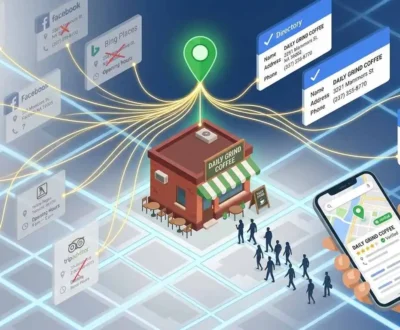
NAP means name, address, and phone number. In the survey, HTML NAP matching the GBP NAP ranks #15. Consistency of citations on the main map platforms, such as Google, Bing, and Apple Maps, ranks #28.
Pick one exact format and use it everywhere. That includes your website footer, your GBP, and every directory. Small differences, like "Street" vs "St.", usually do not matter. A different phone number or an old address does matter. Quality structured citations, such as well-known business directories, rank #49, so add the major ones and skip the long tail of weak directories.
15. Links to Your GBP Landing Page
Quality and authority of links to the GBP landing page rank #25. Links from locally relevant domains rank #26. Links have lost weight for the Map Pack over time, but they still separate close competitors.
Earn local links that exist for a real reason. Think local sponsorships, chamber of commerce pages, supplier pages, and local news. A few relevant guest posts on local blogs can also support this. Point them at the landing page your profile uses.
16. Branded Search Volume
The volume of searches for your business name ranks #23. When many people search for your name, it signals that real people know you. This is the hardest signal to fake.
Build it the slow way. Use local ads, community events, partnerships, and a name people remember. Put your business name on vehicles, receipts, and invoices. Over time, more people will search for you directly.
Real-Time and Behaviour Signals
Some signals change by the hour. They depend on what the searcher is doing right now. Google also watches how people react to your listing, so your profile has to earn clicks as well as rank.
17. Open at the Time of Search and Accurate Hours
"Business is open at time of search" ranks #5 for the Map Pack. It is new in the 2026 survey. Proper hours set on the profile rank #21.
Set exact hours for each day. Update holiday hours before the holiday, not after. Some local SEOs report that rankings dip near closing time, but Google has not confirmed this. If your best customers search in the evening, your hours may be costing you visibility.
18. Click-Through Rate and Engagement from the Pack
Click-through rate from the Local Pack and Maps results ranks #13. Engagement signals on the GBP, like scrolling, tapping sections, and reacting to reviews, rank #33. Requests for driving directions rank #41.
Make your listing the one people choose. Use a clear primary photo, real photos of your work, and a profile that answers questions fast. Experts cannot prove how much Google uses these signals, so treat them as a tiebreaker. Better engagement also brings in more customers on its own.
The Lever Most Guides Skip (Removing Spam Competitors)
Removing spam listings through spam fighting ranks #19 for the Map Pack. That puts it above several signals owners spend months on. In some markets, fake listings can take spots that real businesses should hold.
Check the top results for your main search. Look for a business name stuffed with keywords, a fake address, or a virtual office. Use the "Suggest an edit" option on the listing to report the problem.
Keep proof, like street-level photos and screenshots of the listing. Google's guidelines clearly ban these tactics, but removal can take time and is never guaranteed.
What Barely Moves the Map Pack (Common Myths)
Some popular tactics sound strong but do little for rankings. Skipping them saves you time and money. Some still help customers, so they are not useless.
- "Google Posts will lift my ranking." Posts have a weak effect on ranking at best. They help more with conversion, because they show offers and updates to people who already found you.
- "Keywords in review replies will help." Replying to reviews may give a small ranking benefit. Keywords inside your replies do almost nothing. Reply for your customers.
- "I can pay Google for a better spot." Google says there is no way to request or pay for a better local ranking. Ads and Local Services Ads are separate placements.
- "Q&A will help my profile." Google has been retiring the public Q&A feature, so it is no longer a lever.
- "A long keyword-filled description will help." Experts commonly report little ranking effect from description keywords. Write it for people.
Things That Can Tank or Suspend a Profile
Some mistakes do more than slow you down. They can remove you from the Map Pack entirely. Google's guidelines are clear about what puts a profile at risk.
| Mistake | Why It Hurts | Fix |
| Keywords added to the business name | Google says extra information in the name can lead to suspension. | Use your real-world name only. |
| Virtual office or mailbox as address | Google says these locations are not eligible. | Use a real location or a service area setup. |
| More than one profile for one location | Google allows one profile per location. | Merge or remove duplicates. |
| Incentivized or gated reviews | Google bans incentives and selective asking. | Ask every customer and offer nothing in return. |
| Fake or bulk reviews | Google removes reviews that follow unusual patterns. | Build reviews slowly with real customers. |
| Wrong or ineligible category | Wrong categories hurt relevance. | Pick categories that match your real services. |
| Profile marked closed by mistake | A closed profile cannot match searches from people who want an open business. | Check the status and hours after every edit. |
If your profile is suspended, fix the cause first. Then ask Google to review the profile and send proof that the business is real. Do not create a second profile for the same location, because Google allows only one.
The AI Layer (Ask Maps and AI Mode)
Google is adding AI to Maps. In December 2025, Google confirmed it was removing Questions and Answers from Maps and replacing it with an AI-powered Ask feature. Customers type a question and get an instant answer. Reports say the answer draws on business-provided answers and reviews.
This raises the value of two things you already control. A complete profile gives the AI facts to use. Detailed written reviews give it real customer language to quote. The 2026 Whitespark survey also added AI search visibility as a new area for experts to score, so this layer is now part of local SEO.
Treat this as an extension of the same work, not a separate project. If you want your content to show up in AI answers too, read this guide on keyword research for AI Overviews and ChatGPT citations.
Why Isn't My Business in the Map Pack (A Diagnostic Checklist)
If you are missing from the Map Pack, one signal is usually the bottleneck. Find it before you spend money on fixes. Work from the top of this table and stop at the first row that matches.
| Symptom | Likely Cause | Fix |
| No profile appears at all | Unverified or suspended profile | Verify the profile and check for policy issues. |
| You rank only near your own address | Weak prominence | Build reviews, links, and branded searches. |
| You rank for your name but not your service | Wrong or weak categories and services | Fix the primary category and add services. |
| Rankings drop in the evening | Open-at-search-time effect | Review your hours and test later hours. |
| Competitors with fewer reviews outrank you | Better category or closer location | Compare categories and address city. |
| Rankings fall after a profile edit | Name, category, or address changed | Reverse the change and track the result. |
| Spam listings sit above you | Fake competitors in the pack | Report them and keep proof. |
A full SEO audit can spot website and landing page problems that hold your profile back. Once you find the bottleneck, ongoing monthly SEO packages can keep the fixes moving.
How to Measure Map Pack Rankings Correctly
Tracking your progress on Google Maps ranking factors only works with clean data. Do not check your rank by searching from your office. Local results change by location, device, time, and even the searcher's own history.
Even an incognito window does not give a neutral view. A single search is only one data point.
Use a grid rank tracker instead. It checks your rank from many points around your business and builds a map. Watch two numbers. The first is your average rank across the grid. The second is the share of grid points where you appear in the top 3.
Follow these rules to keep your data honest.
- Log every check. Write down the keyword, the location, the device, and the date.
- Change one thing at a time. This shows you which signal moved the result.
- Compare like with like. Scan at the same time of day, because open-now effects can change results.
- Separate rankings from results. GBP calls count call-button taps, not finished calls. Search Console position is not your Map Pack position.
Final Thoughts
Google Maps ranking factors are not a mystery. Relevance, distance, and prominence explain almost all of it. Start with the primary category, fix your address and pin, and build a steady flow of real reviews.
If you want help, an experienced SEO agency for small businesses can find your bottleneck faster. That is exactly the work SEOviser does.
Most Common FAQs on Google Maps Ranking Factors
What Are the Three Main Google Maps Ranking Factors?
The three main factors are relevance, distance, and prominence. Google lists them on its own help page. Relevance is how well your profile matches the search. Distance is how far you are from the searcher. Prominence is how well-known you are. Google says it is based on how many websites link to you and how many reviews you have.
What Is the Single Most Important Google Maps Ranking Factor?
In the 2026 Whitespark survey, the primary GBP category ranks #1 for the Map Pack. Proximity to the searcher sits a close second, just two points behind. You cannot change proximity, so the category is the best place to start. Choose the most specific category that matches your main service.
Can I Rank on Google Maps Without Showing My Address?
Yes. Service area businesses can rank without a public address, and Google tells them to hide it if they visit customers. The trade-off is that showing an address ranks #7 in the survey. If you hide it, keep your service area realistic and make sure your verified location and pin are accurate.
Why Does My Maps Ranking Drop in the Evening?
The likely cause is the open-at-search-time factor, which ranks #5 for the Map Pack. If you are closed or close soon, Google may show open businesses first. Some local SEOs also report dips in the last hour before closing, but Google has not confirmed that. Check your hours and test whether later hours help.
Do Google Posts Help Maps Rankings?
Posts have a weak effect on ranking at best. They are better for conversion, because they show offers and updates to people who already found your profile. Use them to win customers, not to move up the pack.
Does Responding to Reviews Improve Rankings?
Replying to reviews may give a small ranking benefit. Keywords inside your replies do almost nothing. Google also says helpful replies help a business stand out. Reply to show customers you care.
Do Keywords in Customer Reviews Help?
Moderately. Keywords in native Google reviews rank #36 in the 2026 survey. Never script reviews or offer rewards for them, because Google bans incentives. Ask for honest detail, such as "tell us what we fixed", and let customers use their own words.
Can I Pay Google to Rank Higher on Maps?
No. Google says there is no way to request or pay for a better local ranking. Google Ads and Local Services Ads are separate placements. They can put you in front of customers, but they do not change your organic Map Pack rank.
Does My Website Affect Map Pack Rankings?
Yes. The effect comes mainly through the GBP landing page and the links pointing to it. In the survey, on-page signals carry about 15% of Map Pack weight. Make the page title, headings, and content match your profile.
What Happened to Google Business Profile Q&A?
Google has been retiring public Q&A in Maps. It is being replaced by an AI-powered Ask feature that answers customer questions using business information and reviews. Keep your profile complete and your reviews detailed, because they feed the answers.
Can I Outrank Closer Competitors on Google Maps?
Yes, but it takes work. Proximity ranks #2, so a closer rival starts with an edge. Primary category, reviews, and your landing page can still beat it. Run a grid scan to see where you already win and where distance blocks you.
Do I Need a Website to Appear in the Map Pack?
A profile can appear without a website. A good website still helps, because the GBP landing page signals rank #17 and #20 in the survey. Link your profile to a page that matches your main service and city.
How Long Does It Take to Rank on Google Maps?
There is no fixed timeline. It depends on your competition and on which signal is holding you back. A category fix can show results within weeks in a quiet market. Building reviews and links in a crowded market takes months. Track your grid scans to see progress.
Faisal Mustafa is an Online Market Specialist. He has been providing result oriented quality SEO services to clients worldwide successfully since 2008. He has hundreds of reviews and feedbacks on marketing forums. He is the admin of SEO viser team and a successful online marketer.
OUR SERVICES


Request a free quote
We offer professional SEO services that help websites increase their organic search score drastically in order to compete for the highest rankings even when it comes to highly competitive keywords.
More from our blog
See all posts