


The Ultimate Guide to Keyword Research for SEO (Modern 2026 Framework)
- November 17, 2019
- SEO
A strong Keyword Research Guide is the starting point of every successful SEO campaign. In 2026, Keyword Research for SEO is no longer just about finding popular search terms. It's about understanding what your audience wants, why they search, and how AI-powered search engines interpret their questions.
Working with an experienced SEO Provider in Bangladesh can help you build an SEO strategy that performs well in both traditional search results and AI-driven search experiences.
Many websites struggle to rank because they focus on search volume alone. They target broad keywords that are difficult to compete for while ignoring the specific questions and problems that real customers search every day. As a result, they attract less-qualified traffic and miss valuable opportunities to generate leads and sales.
Modern keyword research in SEO is about finding the right balance between Search intent, business value, and ranking opportunities. It helps you discover what your audience is really asking, identify high-converting long-tail keywords, understand keyword difficulty, and build a smarter SEO content strategy that attracts the right visitors instead of just more visitors.
In this Keyword Research Guide, you will find a proven framework for the modern keyword research process.
We'll cover how to do keyword research, choose the right keyword research tools, analyze competitors, prioritize keywords that support your business goals, and organize them into topical clusters that help your website rank in Google, AI Overviews, ChatGPT, Gemini, and other AI-powered search platforms.
Why Keyword Research is the Bedrock of AI-Era SEO
Keyword research for SEO still matters in 2026, but the goal has shifted from chasing traffic to chasing the right traffic. Every piece of content you publish should trace back to a real, validated demand signal, not a guess.
The Shift from Volume to Value
Search volume alone is a vanity metric if the keyword doesn't lead to brand awareness or conversions. A keyword with 10,000 monthly searches that never converts is worth less than one with 200 searches that consistently turns into sales.
Stop ranking pages by volume first. Rank them by what happens after someone lands on the page. Does it build trust, capture an email, or move someone toward a purchase? If a keyword can't answer yes to one of those, it's not worth the content budget, no matter how big the number looks in your keyword research tools.
Language Pattern Discovery
Real keyword research means learning the exact words your audience uses, not the words your marketing team prefers. Brands write "premium skincare solutions." Shoppers type "best face cream for dry skin that doesn't break me out."
This gap between marketing language and real language is where most content fails to rank. Read reviews, support chats, and comment sections to capture the actual phrasing people use, including their objections and specific problems. That raw language becomes your best source of long-tail keywords later in the process.
Buying Journey Mapping
Every query tells you where a person sits in their buying journey, and your content needs to match that stage exactly. A search for "what is retinol" comes from someone early in research. A search for "buy retinol serum" comes from someone ready to purchase.
Map each keyword to a funnel stage before you write anything. Mixing stages confuses both the reader and the AI engines summarizing your page, since neither knows whether to treat your content as educational or transactional.
Getting this right also affects how many keywords a website should have, since funnel mapping naturally limits you to terms that genuinely deserve their own page.
Phase 1: Modern Keyword Discovery Beyond the "Seed"
Real keyword discovery in 2026 goes far past typing one term into a tool and exporting a list. The best opportunities usually live outside standard keyword research tools entirely.
Mining the "Chunky Middle" and Long-Tail
Roughly 75% of all search demand lives in specific, high-converting long-tail keywords, not the broad head terms everyone fights over. The "chunky middle" sits between single broad words and ultra-specific four-word phrases, and it's often where the real opportunity hides.
Instead of competing for "running shoes," look at phrases like "best running shoes for flat feet women." These terms have lower individual search volume but add up to far more total traffic when you cover enough of them, and they convert at a noticeably higher rate because the searcher already knows what they want.
The Competitor Gap Analysis
Competitor keyword analysis shows you exactly where rivals rank, and you don't, turning their existing success into your roadmap. This is one of the fastest ways to find proven demand without guessing.
Pull a competitor's top organic keywords using a tool like Ahrefs or Semrush, then filter for terms where they rank but you have no page at all. These gaps are validated opportunities, since someone else is already capturing that traffic. Prioritize gaps where the ranking pages are weak, thin, or outdated, since those are the easiest to outrank with genuinely better content.
YouTube & Social Listening
YouTube comment sections and Reddit threads surface unanswered pain points that standard keyword tools simply don't track. People ask blunt, specific questions in these spaces that never show up in keyword volume data because they haven't been searched at scale yet.
Search your topic on Reddit and skim the comments on relevant YouTube videos. Look for repeated questions, confusion, or complaints. These often become tomorrow's high-volume search terms, which means you can publish content months before your competitors even notice the demand exists.
First-Party Data Integration
Support tickets and sales discovery calls contain some of the highest-intent keyword phrases you'll ever find, and almost no one mines them. These are real questions from real buyers, already filtered through genuine purchase intent.
Ask your support team to flag recurring customer questions. Review sales call transcripts for the exact phrasing prospects use to describe their problem. This first-party data often reveals keyword opportunities your competitors haven't found yet, since it comes directly from your own buyers rather than a public search index.
Phase 2: Analyzing the "Keyword Tripod"
Once you have a list of candidate keywords, every one of them needs to pass a three-part test before it earns a place in your content plan. Skipping this step is how teams end up writing content that never ranks or never converts.
The Tripod Rule
Balance Popularity (search volume), Difficulty (how attainable the ranking is), and Relevance (search intent match) for every keyword you consider. A keyword that's strong on only one or two of these legs usually isn't worth the investment.
A high-volume term with low relevance to your business wastes content budget. A low-difficulty term with no search volume wastes it differently. The keywords worth prioritizing sit in the sweet spot where all three factors line up reasonably well.
Demystifying Search Volume
An annual average search volume number can be deeply misleading for seasonal or trending topics. A keyword showing "2,400 average monthly searches" might actually mean 20,000 searches in December and near zero the rest of the year.
Check the monthly trend, not just the yearly average, especially for anything tied to a season, holiday, or news cycle. Building a whole content strategy around an average that hides a massive spike-and-drop pattern leads to wasted effort and disappointing traffic reports.
Keyword Difficulty (KD) Reality Check
A keyword difficulty score only tells part of the story; you also need to manually assess the authority of the current top 10 results. Two keywords with the same KD score can have completely different real-world attainability.
Look at who's actually ranking. Are they all major brands with massive backlink profiles, or a mix of smaller sites? Check whether the topic is genuinely "link-worthy," meaning other sites would naturally want to reference it. A low KD score next to ten domain authority giants is far harder to crack than the number suggests.
Click Potential vs. AI Overviews
Some queries get answered directly on the search results page by an AI Overview, while others still require a full click through to a website. Knowing which is which before you invest in content changes your entire strategy.
Purely informational, single-fact queries ("what is keyword difficulty") get absorbed by AI Overviews at an extremely high rate. Transactional and comparison queries ("best CRM for small teams," "buy noise cancelling headphones") still drive real clicks because AI summaries can't complete a purchase decision on their own.
Weight your content calendar toward the queries that still reward a click, and treat purely informational terms as authority-building and AI-citation plays instead of traffic plays.
Phase 3: The Experience-Based Prioritization Workflow
With your keyword list validated against the tripod, the next step is prioritizing which terms actually get written first. Not every viable keyword deserves equal priority.
Business Potential Scoring
Score every keyword on a 0 to 3 scale based on whether your product is the genuinely irreplaceable solution for that query. A score of 3 means your product is close to the perfect answer. A score of 0 means the connection is weak or forced.
This single scoring step prevents one of the most common mistakes in content planning: writing for keywords with great search volume but a weak or nonexistent connection to what you actually sell. High business potential keywords should always be prioritized over high-volume ones with low relevance.
The Modern Spreadsheet Setup
Organize your validated keywords into one shared spreadsheet that serves SEO, content, and paid campaigns at the same time. Siloed keyword lists across different teams create duplicate work and missed opportunities.
Include columns for search volume, keyword difficulty, business potential score, funnel stage, current ranking page (if any), and target content type. This becomes your single source of truth for keyword research SEO work across every team, and it makes the keyword research process repeatable instead of a one-time exercise that gets forgotten after the first round.
Treating keyword research in SEO as a living document, rather than a static report, is what separates teams that adapt quickly from teams that keep working off outdated data.
Keyword Cannibalization Audit
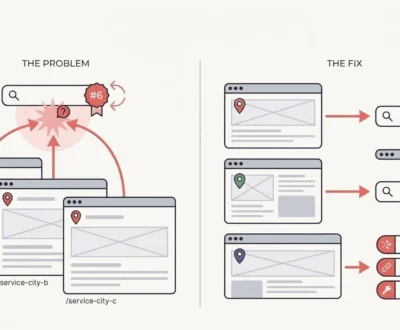
Check whether you already have an existing page that could compete with the new page you're about to create. Publishing two pages that target the same keyword splits your ranking signals and confuses search engines about which one to rank.
Search your own site for the target keyword before writing anything new. If a page already covers similar ground, update or expand that page instead of creating a competing one. This single audit step solves one of the most common, self-inflicted ranking problems we see during client audits.
Mistakes to Avoid
Keyword stuffing and chasing high-volume "vanity" terms with ambiguous intent are the two mistakes that waste the most content budget. Both come from optimizing for the wrong signal.
Stuffing a keyword unnaturally throughout a page reads as robotic to both readers and Google's spam systems, and it does nothing for AI engines trying to extract a clear answer. Chasing a broad, ambiguous term just because the volume looks impressive usually means writing content with no clear intent match, which converts poorly even if it ranks. Better keyword research tips always come back to one principle: relevance and intent first, volume second.
Phase 4: Implementation through Topical Clustering
Individual keywords matter less in 2026 than the topical structure you build them into. Search engines and AI systems both reward sites that demonstrate depth across a connected set of subtopics, not isolated pages chasing single terms.
Pillar and Cluster Content Hubs
Group related keywords into a pillar page supported by linked cluster articles to strengthen the semantic relationship between them. This structure signals topical authority far more effectively than scattered, unrelated posts ever could.
Build one comprehensive pillar page around your core topic, then publish narrower cluster articles that each cover a specific subtopic in depth. Link the cluster pages back to the pillar and to each other where relevant.
This internal linking pattern helps both search engines and AI crawlers understand how your content connects, which strengthens your overall topical authority.
The Parent Topic Advantage
A single, well-built page can rank for hundreds of related keywords if it's structured around the right "parent topic" instead of one narrow term. This is far more efficient than writing a separate thin page for every keyword variation.
Identify the broader parent topic that several of your validated keywords share, then build one thorough page that genuinely covers all the related angles. A well-researched guide naturally picks up rankings for dozens of variations and long-tail keywords without you needing to target each one individually.
Natural Keyword Placement
Place your focus keyword in the title, the first 100 to 150 words, at least one heading, and naturally throughout the body without sacrificing readability. Forced placement that breaks sentence flow hurts more than it helps.
Write the sentence first, in plain, natural language. Then check whether the keyword fits without sounding awkward. If it doesn't fit naturally, use a close variation instead. Readability and natural language always come before exact-match keyword density, especially now that AI engines reward clear, human writing over mechanically optimized text.
Final Words
A modern keyword research guide isn't a one-time spreadsheet exercise anymore. It's a recurring process that mixes traditional search volume data with social listening, first-party customer language, and a clear understanding of which queries AI Overviews will absorb versus which ones still drive a click.
Get the discovery phase right, run every keyword through the tripod test, prioritize by genuine business potential, and organize everything into topical clusters instead of scattered pages.
This entire workflow only works when it sits inside a single, connected SEO content strategy rather than separate, disconnected tasks owned by different teams. Keyword research feeds content planning, content planning feeds internal linking, and internal linking feeds the topical authority that both Google and AI engines reward.
Businesses that treat keyword research as an ongoing process, not a one-time task, keep finding new growth opportunities. If you need help building or improving your keyword strategy, our team is here to help.
Most Common FAQs on Keyword Research for SEO
What is the difference between short-tail and long-tail keywords?
A short-tail keyword is broad and usually one or two words, like "shoes," with high search volume but low specificity. A long-tail keyword is longer and more specific, like "best running shoes for flat feet," with lower volume but much higher buying intent. Long-tail terms are usually easier to rank for and convert better, since the searcher already knows exactly what they want.
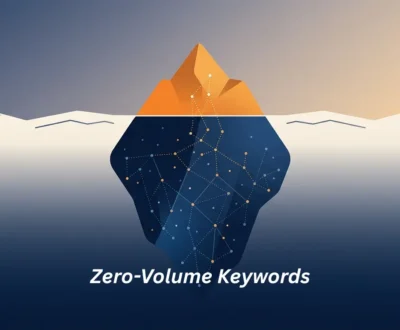
How do you find keywords with zero search volume that actually drive sales?
Look at support tickets, sales call transcripts, and live chat logs for the exact phrases customers use before buying. Many high-intent, very specific questions show zero volume in keyword tools simply because they haven't been searched often enough yet to register. These terms often convert at a much higher rate than anything you'd find through standard keyword research.
What is search intent and why does it matter for SEO?
Search intent is the real reason behind a search, whether someone wants information, is comparing options, or is ready to buy. Matching your content to the correct intent matters more than matching the exact keyword, since Google and AI engines both rank pages based on how well they satisfy what the searcher actually wants. A perfectly optimized page with the wrong intent still won't rank.
How has AI search (like AI Overviews) changed keyword research?
AI Overviews now answer most purely informational queries directly on the results page, which means fewer clicks for content that just defines a term or answers a simple fact. Keyword research now needs to separate "AI Overview will absorb this" terms from "this still earns a click" terms, usually transactional or comparison queries, and weight content priorities toward the keywords that still drive real traffic.
Can you rank for keywords that you don't use in your text?
Yes, to a degree. Google understands semantic relationships and synonyms well enough to rank pages for related terms that never appear verbatim on the page. That said, your primary focus keyword and its natural variations should still appear in key spots like the title and intro, since exact relevance signals still carry real weight for both traditional rankings and AI citation.
How do you conduct a keyword gap analysis against competitors?
Pull a competitor's full list of ranking keywords using a tool like Ahrefs or Semrush, then filter for terms where they rank in the top 10 but you have no page targeting that term at all. Prioritize gaps where the competing page is thin, outdated, or low quality, since those are the easiest wins. This turns proven competitor demand into your own content roadmap.
Is keyword density still a ranking factor in 2026?
Not as a strict numerical target. Google moved away from rewarding a specific keyword percentage years ago, and AI engines actively penalize text that reads as stuffed or unnatural. What still matters is natural keyword placement, where your focus term and its variations appear where a reader would expect them, without breaking the flow of normal, readable sentences.
Ruth Carol is a professional SEO expert providing services concerning to search engine optimization process. She has 10 years long experience with vast knowledge in the field of modern search engine optimization process and is continuing. Her educational background, along with her working experience in this field, enables her to gain ample knowledge in this subject area. She was an active volunteer in google serve program and a regular blog writer subjecting SEO optimization process and special tips. Follow her blogs on seoviser. Besides, she is an active member of the Chang Mei International SEO Conference. Furthermore, she is the founder of SEO Viser, which is an SEO agency providing SEO solutions all over the world. She aims to help companies ranging from small to big to develop a long-lasting solution to rank their site. Apart from that, she provides consultancy services related to search engine optimization and contributing to social media and online platforms like Fiverr, Upwork, etc. To know more about her services and anyone can visit seoviser or simply email her through her website. She is a great mind and loves to share knowledge. Contact her at seoviser.
OUR SERVICES


Request a free quote
We offer professional SEO services that help websites increase their organic search score drastically in order to compete for the highest rankings even when it comes to highly competitive keywords.
More from our blog
See all posts






Pingback: How Many Keywords Should a Website Have - SEOviser