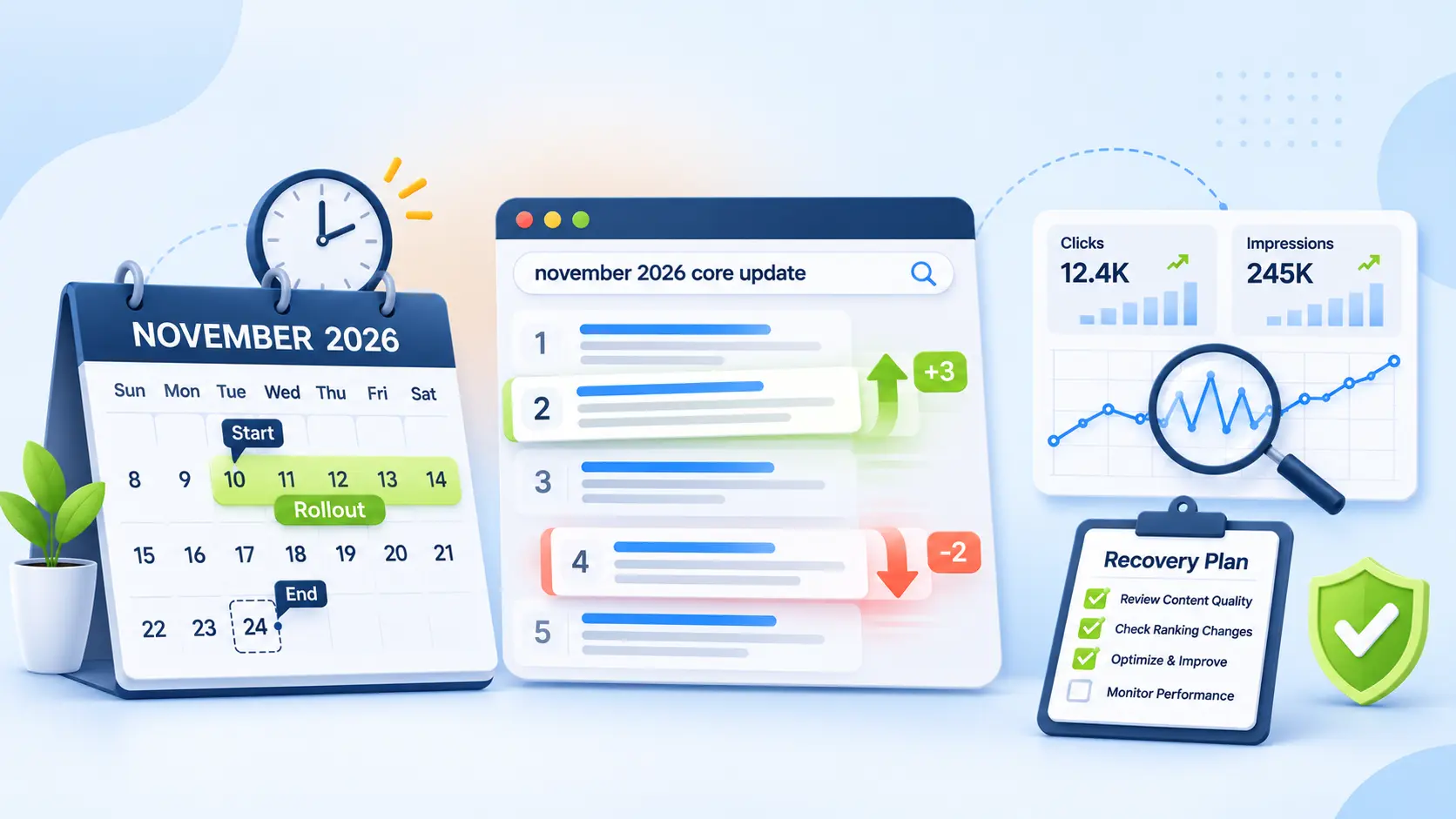
The November 2026 core update started rolling out on November 10, 2026. Google says it applies to every country and language and may take up to two weeks to finish.
If your traffic moved this week, this is the most likely reason. Rankings swing during a rollout. A drop in the first few days often reverses before the end. We wrote this guide at SEOviser to explain what changed and what to do next. We'll keep it updated until Google says the rollout is complete.
Quick answer
Google's November 2026 core update began on November 10, 2026, and should finish around November 24. It affects sites in all countries and languages. It isn't a penalty, so the most useful thing to do this week is save your data and wait.
| Detail | Answer |
|---|---|
| Official name | November 2026 core update |
| Type | Broad core update (not a spam update) |
| Start date | November 10, 2026, 10:06 AM Pacific |
| Expected end | Up to 2 weeks, around November 24, 2026 |
| Where | All countries and languages |
| Can affect | Web search rankings, Google Discover, featured snippets |
| Is it a penalty? | No. Google says core updates don't target single sites or pages |
| Number this year | Third core update of 2026, after March and May |
| What to do now | Save your traffic data, hold off on big site changes, and wait for the rollout to end |
| Official source | Google Search Status Dashboard |
In this guide:
- What the November 2026 core update is
- Timeline and rollout length
- What Google said and what it may focus on
- Who is most likely to be affected
- What to do right now
- How to check if your site was hit
- How to recover
- Tips for local, ecommerce, blog and Bangladeshi sites
- FAQ
What is the Google November 2026 core update?
Google changes its ranking systems all the time, mostly in small ways nobody notices. A few times a year, it makes a bigger change to its main systems and announces it. That's a core update. Think of a librarian re-sorting the shelves. No books are removed, but some move to the front and others move back.
You may also see this one called the November 2026 Google update, or the Google algorithm update for November 2026. They refer to the same rollout.
When Google announced the November 2026 core update, it gave one line of description: "a regular update designed to better surface relevant, satisfying content for searchers from all types of sites."
Google's own core updates guide says most sites don't need to worry about core updates. It also says a page that drops may have nothing wrong with it. Another page may simply answer the search better now.
Timeline of the update
We add new entries at the top as the rollout moves.
| Date | What happened |
|---|---|
| November 11, 2026 | Still rolling out. No completion notice yet. |
| November 10, 2026 | Google posted the update on its Search Status Dashboard at 10:07 AM Pacific and on its Search Central LinkedIn page. |
| November 8 to 9, 2026 | Rank trackers picked up big ranking moves before the announcement, and some SEOs expected an update. |
| October 1, 2026 | Google added new text to its helpful content guide about main content and fake author profiles. |
| September 24 to October 8, 2026 | The September 2026 spam update ran, Google's longest spam update of the year. |
| May 21 to June 2, 2026 | The May 2026 core update ran. |
The gap before this update was unusually long. About 173 days separated the May and November releases, the longest gap between core updates this year.
How long will the rollout take?
Google says up to two weeks. Across 23 earlier core updates, the median rollout was about 14 days, though the range runs from 6 days to 45.
| Past core update | How long it took |
|---|---|
| May 2026 | About 12 days |
| March 2026 | About 12 days |
| December 2025 | About 18 days |
| December 2024 (shortest) | About 6 days |
| March 2024 (longest) | About 45 days |
If this November 2026 Google update follows the usual pattern, it will finish in the last week of November. We'll change the status box at the top when Google confirms it.
What Google said, and what it didn't
Google confirmed very little. The update covers all countries and languages. The rollout may take up to two weeks. Google calls it a "regular update" meant to show relevant, satisfying content.
It didn't publish a blog post, list the systems that changed, or name any industry. So anyone who claims to know exactly what this update targets is guessing. What we can do is look at this year's earlier updates and at the guidance Google has changed since May.
What this update might focus on
Google hasn't confirmed any of the points below for this update. They come from patterns in the March and May 2026 core updates and from guidance Google changed in October.
1. Matching the page to the search
In May, page type seemed to matter more than brand size. Aleyda Solis studied Sistrix data for the US and UK. Her May 2026 core update analysis found that visibility moved toward the kind of page that best fit each search. Sites where people finish a task, like booking travel or applying for a job, gained. Sites that mostly repackage other sites lost ground. Some big, trusted sites slipped when they weren't the type of result people wanted. In the UK, local store sites like amazon.co.uk beat their .com versions.
For site owners, the lesson is that search intent carries a lot of weight right now.
2. Directories and comparison sites
March hit these sites hardest. SE Ranking found that 79.5% of top-three results changed position. About 24.1% of top-ten pages dropped out of the top 100. In Sistrix data, aggregators, directories, and comparison sites had the biggest losses.
3. Main content quality
On October 1, Google added a new section to its guide on helpful, people-first content. It defines main content as the part of a page that does its job. That could be an article, a tool, or a calculator. Google says main content quality is one of the most important things it checks.
The guide lists four things its quality raters look at:
| What raters check | What it means |
|---|---|
| Effort | Someone put real work into the page |
| Originality | It adds something new instead of repeating other pages |
| Skill | The writer clearly knows the subject |
| Accuracy | The facts are right, with a higher bar for health, money, and safety topics |
Since March 2024, Google's helpful content signals have been part of its core ranking systems. So changes to this guidance usually show up through core updates like this one.
4. Real authors
The same October edit added a clear warning about fake author profiles. Google now treats AI-made headshots, invented names, and false claims of expertise as deception. A writer posing as a doctor is one example. This ties into E-E-A-T, which stands for experience, expertise, authoritativeness, and trust.
5. AI content without review
Google also updated its AI content guidance on October 1. It now says to fact-check and review AI content by hand. Using AI to write isn't against Google's rules. Publishing lots of low-value pages just to rank is. Google calls that scaled content abuse, whether a person or a tool made the pages.
Who is most likely to be affected?
Almost every site sees some movement from a Google algorithm update like this one. Based on this year's patterns, these are the sites we'd watch most closely:
- Blogs with thin or copied articles
- Directories and comparison sites that mainly list other sites
- Affiliate sites without hands-on testing
- Online stores using the manufacturer's product descriptions
- Local businesses with many near-identical city pages
- Sites with a lot of unedited AI content
- Sites with fake or vague author information
Sites outside these groups can drop too, at least for a while. Movement during a rollout doesn't on its own mean anything is wrong.
Black Friday timing
If the rollout uses the full two weeks, it ends around November 24. Thanksgiving is November 26, and Black Friday is November 27. You won't have a full week of clean data until about December 1, the day after Cyber Monday.
If you run an online store, avoid rebuilding key pages until the rollout ends. Changes made mid-update make it hard to tell what caused what. Keep paid ads ready in case organic traffic dips for a few days. When you check results, compare them with the same weeks in 2025, because holiday traffic swings every year. And watch sales, not just rankings.
Can you trust rank tracking tools right now?
Use them with some caution this month. Several vendors have had trouble collecting clean data since September. DemandSphere reported wrong results in about 11% of its daily checks, and Nozzle flagged around 8% of results pages. Some site owners have also reported odd numbers in the Search Console performance report.
We use outside tools to spot trends, and our own Search Console, analytics, and sales data to make decisions.
Core update vs spam update
The two are often confused, and they need different fixes.
| Core update | Spam update | |
|---|---|---|
| What it does | Re-checks how useful pages are across the whole web | Finds and demotes pages that break Google's spam rules |
| Why you drop | Other pages may now serve the search better | Your site may use tactics Google treats as spam |
| How you fix it | Make your content more helpful over time | Remove the spam tactic, such as bought links or bulk thin pages |
| Example | November 2026 core update | September 2026 spam update |
If your traffic fell between September 24 and October 8, check the spam update first. If it fell after November 10, the core update is the more likely cause.
What to do while the update rolls out
Most of the useful work this week is preparation.
- Hold off on redesigns, mass deletions, and URL changes until the rollout ends. Many early drops recover before the end.
- Export your Search Console data for November 3 to 9, 2026. That's your baseline week for comparing results.
- Write down any site changes you made this month, like moved pages, a new theme, or edited titles. That way you won't blame the update for your own change.
- Log clicks, leads, and sales each day in a simple spreadsheet.
- Keep publishing as normal, but save big experiments for December.
How to check if the update hit your site
Google's advice is simple. Wait until the update is complete, then wait one more full week. After that, compare your Search Console data with the week before the rollout started.
In Search Console:
- Confirm on the Google Search Status Dashboard that the update is marked complete, then wait one more week.
- Open Performance, then Search results.
- Click the date filter, choose Compare, and set the week after the update against November 3 to 9, 2026.
- Check clicks, impressions, click-through rate, and average position.
- In the Pages tab, sort by the largest drop in clicks.
- In the Queries tab, see which search terms gained or lost the most.
Rule out other causes first
A drop in November isn't always caused by the core update. Check these first:
- Is demand for your topic seasonal?
- Is your analytics code still running on every page?
- Does the Pages report in Search Console show indexing errors?
- Is there anything in the Manual actions report? That's a separate penalty from a human reviewer.
- Did the decline start between September 24 and October 8? Then the spam update is the more likely cause.
Small drop or big drop?
| What you see | What it likely means | What to do |
|---|---|---|
| You slipped from position 2 to position 4 | Normal movement | Usually nothing |
| Some pages dropped while others gained | Google re-sorted results for certain searches | Study the pages that lost the most |
| Most pages fell several pages back | The update changed how Google sees your site | Follow the recovery plan below |
Google's guide says a small drop in position isn't a reason for drastic changes.
How to recover from the November 2026 core update
There's no quick fix for a core update drop. Recovery comes from making pages more useful to the people reading them, and it takes time.
Google says some fixes show up within days. Others take months before its systems trust the change. Some sites won't fully recover until the next broad core update. Google's Gary Illyes said in October 2026 that core update recovery usually takes 3 to 6 months. Google also runs smaller core updates it doesn't announce, so you may see progress before the next named one.
This is the order we work in at SEOviser.
Step 1: Find the pages that lost the most
In Search Console, sort pages by lost clicks and start with the top 10 to 20. They usually account for most of the traffic you lost.
Step 2: Check whether your page is the right type
Search your main keyword and look at what ranks now. Is it store pages, guides, videos, local listings, or tools? If the top results are a different kind of page from yours, that's often why you dropped. You can rework your page to fit what searchers want. Or you can point it at a keyword it suits better.
Step 3: Improve the main content
Go through each page with Google's rater questions in mind. Did someone put real work into it? Does it offer something other pages don't, like your own data, photos, or examples? Is it clear the writer knows the subject? Is every fact correct and current? Google also suggests reading your site like an honest outsider would. Would that person be glad they found the page?
Step 4: Show who wrote it
Put a real author name, photo, and short bio on every article. Link to an author page that shows their experience and social profiles. Remove any fake profiles or AI-made headshots.
Step 5: Review AI content
Every AI draft needs a human edit and a fact check, plus experience the AI doesn't have. Pages that were mass-produced to rank should be merged or removed.
Step 6: Update, merge, or remove weak pages
Update pages with outdated facts or missing details. Merge pages that cover the same topic into one. Remove a page only when it can't be saved. When you do, add a 301 redirect to the closest related page.
Step 7: Fix technical issues
Technical problems rarely cause a core update drop, but they can slow recovery. Check page speed, broken links, mobile layout, and indexing errors in Search Console.
Step 8: Measure in batches
Check your data every 2 to 4 weeks. Change one group of pages, wait, and measure. Then move to the next group. This shows you which changes actually helped.
If your site went up
Look at which pages gained and try to work out why. Then apply the same changes to similar pages. Keep those pages accurate and up to date, because the next update can reverse gains too.
Tips by type of website
Local service businesses
Keep your Google Business Profile complete. Add real photos of your team and your work, and ask happy customers for reviews. Give each service area page its own content. Pages that only swap the city name are the kind this year's updates pushed down.
Ecommerce and Shopify stores
Write your own product descriptions instead of using the manufacturer's. Show real reviews and clear shipping and return details. Leave category pages alone until after Black Friday. If you sell in several countries, check the currency, shipping details, and hreflang tags for each market.
Blogs and content sites
Show first-hand experience with your own photos, screenshots, and examples. Answer the question early, then add detail. Refresh your top posts at least every six months.
Websites in Bangladesh
The update is global, so it affects Bangla and English sites in Bangladesh alike. Locally, the rollout started at about 12:06 AM on November 11, 2026.
Show a real business address, phone number, and team. Collect reviews from local customers. If you publish in both Bangla and English, make each version useful on its own, not a rough machine translation. Our guide on how long SEO takes in Bangladesh explains what to expect after you make fixes.
Protecting your site from future core updates
Google will keep releasing core updates. This is the checklist we use between them:
- Write for readers first
- Match each page to what searchers want
- Show real authors with real experience
- Fact-check every page, especially AI drafts
- Add your own data, photos, or examples
- Refresh key pages every six months
- Earn links and mentions naturally
- Review Search Console data monthly
November 2026 core update FAQ
When did the November 2026 core update start?
On November 10, 2026, at 10:06 AM Pacific time, which was 12:06 AM on November 11 in Bangladesh.
When will the November 2026 core update finish?
Google says the rollout may take up to two weeks, which points to around November 24, 2026. We'll update this answer once Google confirms it.
Is the update finished yet?
Not as of November 11, 2026. The Google Search Status Dashboard will show a completion notice when it's done.
Does it affect all countries and languages?
Yes. Google says it applies globally and to all languages.
Is a Google core update a penalty?
No. Google says core updates don't target single sites or pages. A page usually drops because other pages now serve that search better.
Why did my traffic drop during the rollout?
Rankings move a lot while an update is rolling out, so the drop may be temporary. Wait until the update ends, plus one more week, before you judge it.
How long does it take to recover from a core update?
Usually 3 to 6 months, and some sites have to wait for the next broad core update. Smaller gains can come sooner, since Google also runs smaller updates between the named ones.
Does the November 2026 core update affect Google Discover?
It can. Core updates often affect Google Discover and featured snippets as well as regular search results.
Does this update hurt AI content?
Google hasn't said it targets AI content. AI-assisted content is fine when it's helpful, accurate, and reviewed by a person. Mass-produced, low-value pages break Google's spam rules regardless of how they were made.
Should I change my website now?
Not in any major way. Save your data and keep working as usual. Once the rollout ends and another full week has passed, make changes based on what the data shows.
Need help with this update?
SEOviser is one of the leading SEO agencies, with teams in the US and Bangladesh. We help local businesses, ecommerce and Shopify stores, and growing brands find out why their rankings changed. Then we show them what to fix first. Our audits cover content, search intent, authorship, and technical health, and end with a clear plan.
If your traffic dropped after this update, book a free consultation with SEOviser. We'll go through your data with you and tell you where you stand.
Final thoughts
The November 2026 core update is Google's third core update of 2026 and the first since May. Early movement is unreliable, so don't rush. Wait for the rollout to finish. Compare a clean week of data with November 3 to 9. Then start with the pages that lost the most.
We'll update this page when Google confirms the rollout is complete, and again once reliable data on winners and losers is available.
Faisal Mustafa is an Online Market Specialist. He has been providing result oriented quality SEO services to clients worldwide successfully since 2008. He has hundreds of reviews and feedbacks on marketing forums. He is the admin of SEO viser team and a successful online marketer.
OUR SERVICES


Request a free quote
We offer professional SEO services that help websites increase their organic search score drastically in order to compete for the highest rankings even when it comes to highly competitive keywords.
More from our blog
See all posts