Searching for how to implement llms.txt?
You may be looking for an easy way to improve your visibility in AI search, but llms.txt is not a confirmed ranking shortcut.
As of 2026, no major AI search engine has publicly confirmed that llms.txt directly improves rankings or guarantees that your pages will be cited.
So, does that mean you should ignore it? Not necessarily.
llms.txt is a simple Markdown-formatted text file that you place at the root of your website to give AI systems a clear map of your most important content. It can point AI tools toward key pages, documentation, guides, APIs, and other resources you want them to understand more easily.
Google has stated that it does not currently use llms.txt for AI Overviews or AI Mode. However, the file can still be useful for documentation-heavy websites, software products, developer tools, and sites whose content is frequently used by AI coding assistants such as Cursor and Claude Code.
The important question is not simply “How do I create an llms.txt file?” It is “Does my website actually benefit from having one?”
This blog explains what llms.txt does, where to place it, how to structure the file, and how to implement it step by step.
We will also separate what llms.txt can realistically do from the SEO and AI visibility claims it cannot support, so you can decide whether it deserves a place in your AI search strategy.
What llms.txt Does (Briefly)
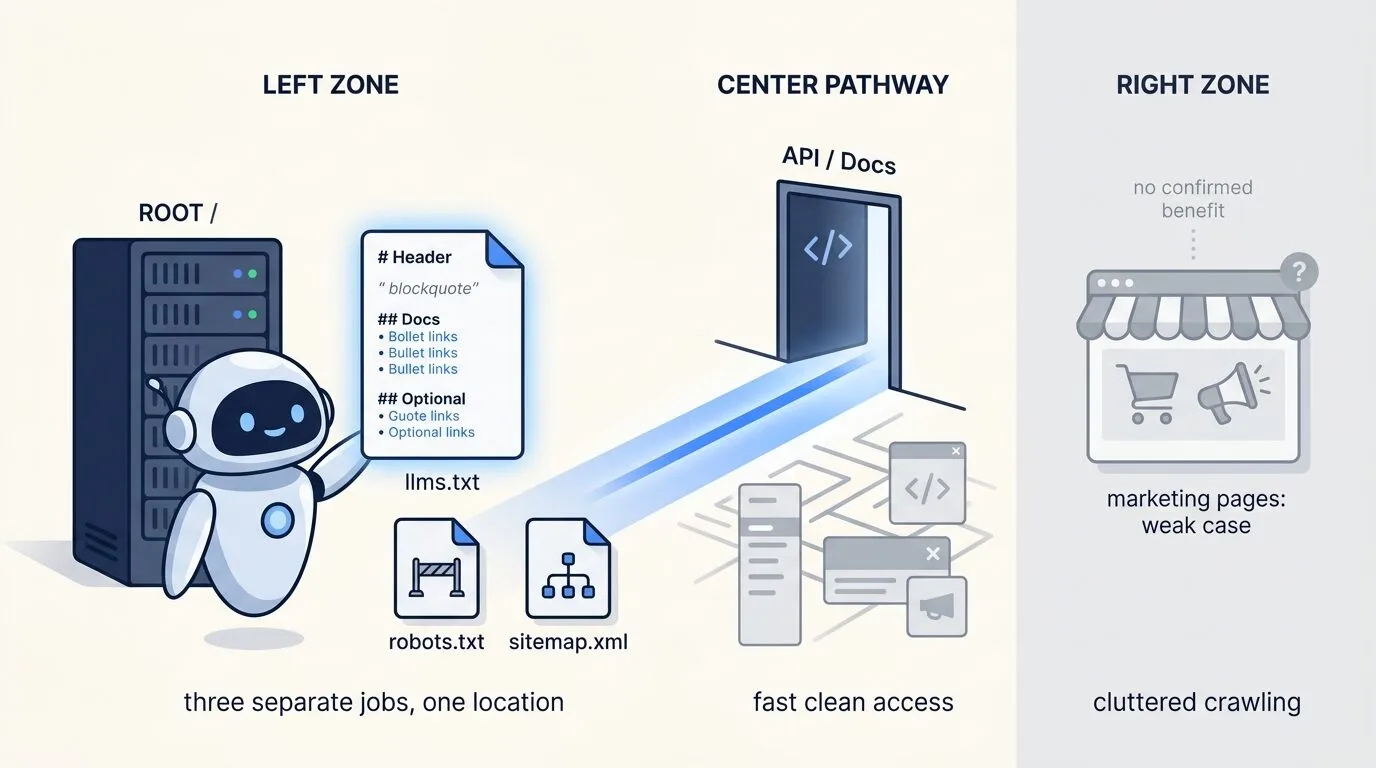
llms.txt is a curated Markdown map of a website's key pages. It sits at the site's root, built for AI tools that cannot fit an entire website into their context window.
Instead of forcing an AI model to crawl every page and strip out navigation, ads, and script clutter, the file hands over a short list of the pages that actually matter.
It is not the same as robots.txt or sitemap.xml, even though people often lump the three together. Each file does a different job on your site.
- robots.txt tells crawlers what they are allowed to access.
- sitemap.xml lists every indexable page for search engines to crawl.
- llms.txt curates a short, human-written list of pages for AI agents to read on demand.
llms.txt does not take over either of the other two jobs. It fills a gap neither one was built to cover.
Jeremy Howard, co-founder of Answer.AI and fast.ai, proposed llms.txt in September 2024.
The spec lives at llmstxt.org, and it has been updated since, most recently in August 2026, based on two years of real adoption data.
Before You Build One
As of 2026, no major AI provider confirms using llms.txt for search ranking or AI citations. That single fact should shape how much time you spend on this.
Google has addressed this directly, through two separate spokespeople. Both statements point the same direction.
- Gary Illyes, speaking at a Search Central Deep Dive event, said Google does not support llms.txt and has no plans to.
- John Mueller said no AI system was currently using the llms.txt file for search purposes.
For AI Overviews and AI Mode, Google pulls from the same crawling and indexing pipeline it already uses for regular search. Normal on-page SEO and technical health still decide what gets surfaced there, not a root-level text file.
The honest exception sits in agent-to-agent and developer-tool contexts. Coding assistants such as Cursor and Claude Code fetch documentation directly, and llms.txt gives them a fast, clean entry point.
Picture a developer asking Claude Code to add a payment feature using a new API. Without llms.txt, the agent has to crawl the whole docs site, wade through navigation menus and marketing copy, and guess which page actually has the endpoint it needs.
With llms.txt in place, it goes straight to the one page that matters. OpenAI, Anthropic, and Google's own Gemini team publish llms.txt files for their own developer documentation, and that alone tells you where the real use case lives. It sits in dev tools, not in search rankings.
The reality check in one line. No major AI provider has confirmed using llms.txt for ranking or citation as of 2026, and Google has said outright it skips the file for AI Overviews and AI Mode.
If AI Overview visibility is the actual goal, that work still looks like ordinary SEO done properly, not a new file format. A strong seo service agency will tell you the same thing before selling you anything related to llms.txt.
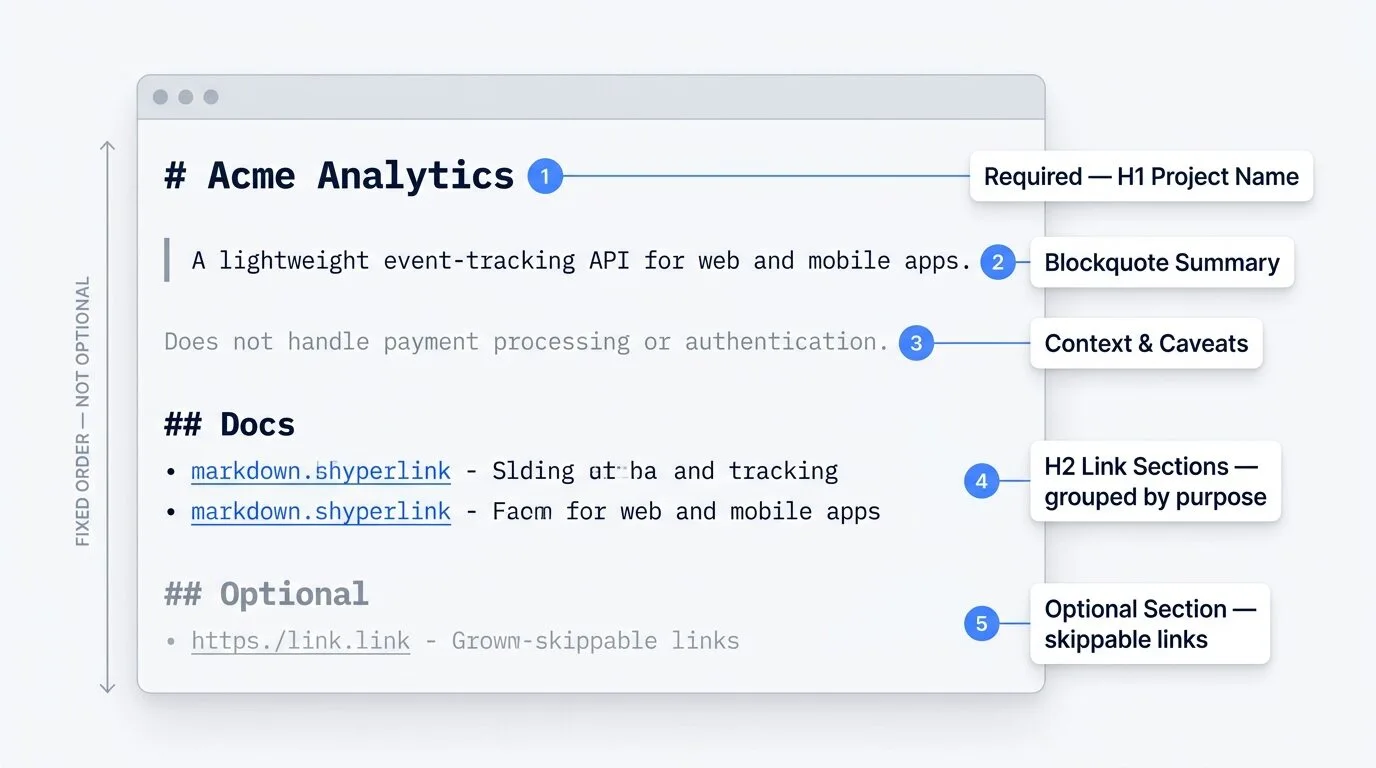
The llms.txt File Format
An llms.txt file follows a fixed structure, and getting this right matters more than the exact wording inside it. The format is simple enough to write in a text editor, but the order of sections is not optional.
A single H1 with your site or project name is the only required section. Everything past that point is optional, though skipping it makes the file far less useful.
- An H1 with the project name. This is the one non-negotiable line, and it should match how you refer to your brand elsewhere.
- A blockquote summary. One or two sentences right under the H1, giving an AI model the fastest possible read on what your site or product actually is.
- Free-form context paragraphs. Notes, caveats, or background that helps a model interpret the linked pages correctly, such as what your product does not do.
- H2-delimited link sections. Groups of links, organized by purpose (Docs, Guides, API Reference), each written as a Markdown hyperlink with a short note.
- An "Optional" H2. A dedicated section for links a model can skip when it is short on context, kept separate from your core pages.
The example below shows the real structure, trimmed down from a live project.
| # Acme Analytics
> Acme Analytics is a lightweight event-tracking API for web and mobile apps. Acme does not handle payment processing or user authentication. ## Docs - [Quick Start](https://acme.dev/docs/quickstart.md): Five-minute setup guide for the tracking SDK - [API Reference](https://acme.dev/docs/api.md): Full endpoint list with request and response examples ## Optional - [Changelog](https://acme.dev/changelog.md): Version history, useful only for migration questions |
Time spent on the llms.txt file format pays off fastest on documentation-heavy sites and SaaS or API products. It also pays off on anything a coding assistant like Cursor or Claude Code is likely to reference while writing code.
A marketing page with no technical documentation gets little from this file, no matter how well it is written.
Knowing this now saves you from spending an afternoon on a file expecting an AI Overview lift or a ChatGPT citation boost. That is not what this format is built to deliver.
How to Implement llms.txt Step by Step
Implementing llms.txt is mostly an editorial task, not a technical one. The steps below take under an hour for most sites, longer only if your documentation itself needs cleanup first.
- Choose your content strategy first. Before writing anything, decide which URLs are actually worth an AI model's time. Documentation, API references, FAQs, pricing pages, and clean canonical product or service pages belong on the list.
Heavy media galleries, thin or duplicate pages, checkout and login flows, and outdated archives do not, and leaving them out keeps the file useful instead of bloated.
- Create the file with the exact name. Name it llms.txt, all lowercase, using a plain text editor such as VS Code or Notepad.
Write the content in standardized Markdown following the structure above, starting with the H1, then the blockquote and optional context, then your H2 link sections. Keep link descriptions factual, not written like ad copy.
- Upload it to your domain root. The file needs to resolve at yourdomain.com/llms.txt and load as plain text, not as an HTML page wrapped in your site template. This is the standard llms.txt root directory placement, matching where robots.txt and sitemap.xml already sit.
- Verify it loads and validates. Open the URL directly in a browser and confirm the raw Markdown displays correctly. Run llms.txt validation against the format rules at llmstxt.org before calling the file finished.
If your documentation platform runs on Mintlify, GitBook, or a similar system, much of this llms.txt setup may already happen automatically. Check your platform's docs before building the file by hand.
Should You Actually Build One?
Whether llms.txt is worth your time depends entirely on what kind of site you run. The decision comes down to one question, does an AI coding agent or documentation reader ever need a fast map of your technical content.
| Site Type | Build One? | Why |
| Documentation-heavy sites | Yes | Coding agents fetch docs directly and benefit from a curated entry point |
| SaaS or API products | Yes | Developers using AI tools need fast, accurate reference links |
| Sites coding assistants reference | Yes | Cursor, Claude Code, and similar tools read llms.txt when present |
| Typical marketing or service pages | Weak case | No confirmed ranking or citation benefit from any major AI provider |
| Local or small business sites chasing AI Overviews | Weak case | That visibility comes from content quality, structure, and trust signals |
For a typical marketing or service page chasing AI Overview or ChatGPT citations, the case is weak.
That time is better spent on content quality, structured data, and clear entity signals, the same groundwork covered under core on-page SEO factors.
The honest way to frame llms.txt is agent readiness, not GEO or AEO. It helps a coding tool find your documentation fast. It does not replace the content and technical work that actually earns AI Overview visibility.
That work still runs through the fundamentals covered under why on-page SEO matters.
Common Myths About llms.txt
A lot of confident claims circulate about what llms.txt does. Most of them do not hold up against what Google and the other major AI labs have actually said.
Clearing these up now saves you from building a strategy on a false premise.
- "llms.txt improves your Google rankings." Google has stated directly that it does not use llms.txt for AI Overviews or AI Mode. There is no evidence it affects standard organic rankings either.
Ranking improvements still come from the signals Google has always used, including page quality and technical health. Even something as specific as image optimization for SEO carries more documented ranking weight than an llms.txt file does.
- "llms.txt guarantees AI citations in ChatGPT or Perplexity." Publishing the file does not obligate any model to read it or cite your content because of it.
Some AI crawlers do fetch llms.txt files, but a fetch is not the same as a guaranteed citation.
- "llms.txt replaces robots.txt or sitemap.xml." These three files serve entirely different purposes and none of them substitutes for another.
robots.txt controls crawler access, sitemap.xml lists indexable pages, and llms.txt curates a shortlist for on-demand AI reading.
- "Every AI crawler reads llms.txt." Adoption is inconsistent across AI labs, and reading behavior differs by tool and by task.
OpenAI's crawlers have been observed fetching llms.txt files on some sites, while Google has stated it does not use the file at all.
Final Words
llms.txt is a simple file with a narrow, honest use case. It gives AI coding agents a fast map to your technical documentation, and that is where its real value sits today.
If you run a documentation-heavy site, an API product, or anything a tool like Cursor or Claude Code might reference, building one is worth the hour it takes. If your goal is Google AI Overview visibility or ChatGPT citations for a typical marketing page, your time is better spent elsewhere. Content quality, site structure, and technical SEO still carry that weight in 2026, and no root-level file changes do that.
Treat llms.txt as one small piece of a much bigger AI-readiness puzzle, not a shortcut around the fundamentals.
Most Common FAQs on How to Implement llms.txt for AI Crawlers
Does Google use llms.txt for AI Overviews or AI Mode?
No. Google's Gary Illyes said directly that Google does not support llms.txt and has no plans to crawl it. AI Overviews and AI Mode draw from Google's standard crawling and indexing pipeline, the same one that powers regular search results.
Does ChatGPT use llms.txt?
Some evidence points to OpenAI's crawlers fetching llms.txt files on sites that publish them, and OpenAI publishes its own llms.txt for developer documentation. That said, no official OpenAI statement confirms the file drives citations or answer selection inside ChatGPT itself.
Is llms.txt required for AI search visibility?
No. AI search visibility comes primarily from content quality, clear structure, and credible sourcing, the same signals that drive normal organic rankings. llms.txt is a helpful add-on for developer-facing sites, not a requirement for showing up in AI answers.
How is llms.txt different from robots.txt?
robots.txt is a permission file that tells crawlers what they can and cannot access on your site. llms.txt is a curated content map meant to be read on demand by an AI agent looking for your best pages. It does not control or restrict crawler access at all.
Do I need llms-full.txt in addition to llms.txt?
Only if your site is documentation-heavy and you want AI agents to ingest full page content in a single fetch. llms-full.txt embeds the complete Markdown content of your linked pages, while llms.txt stays a short index.
One AI-traffic tracking firm reported that llms-full.txt draws noticeably more AI crawler visits than the short version, with ChatGPT accounting for most of that traffic. Marketing sites and small blogs rarely need the full version, but API and developer documentation sites often benefit from shipping both.
Ruth Carol is a professional SEO expert providing services concerning to search engine optimization process. She has 10 years long experience with vast knowledge in the field of modern search engine optimization process and is continuing. Her educational background, along with her working experience in this field, enables her to gain ample knowledge in this subject area. She was an active volunteer in google serve program and a regular blog writer subjecting SEO optimization process and special tips. Follow her blogs on seoviser. Besides, she is an active member of the Chang Mei International SEO Conference. Furthermore, she is the founder of SEO Viser, which is an SEO agency providing SEO solutions all over the world. She aims to help companies ranging from small to big to develop a long-lasting solution to rank their site. Apart from that, she provides consultancy services related to search engine optimization and contributing to social media and online platforms like Fiverr, Upwork, etc. To know more about her services and anyone can visit seoviser or simply email her through her website. She is a great mind and loves to share knowledge. Contact her at seoviser.
OUR SERVICES


Request a free quote
We offer professional SEO services that help websites increase their organic search score drastically in order to compete for the highest rankings even when it comes to highly competitive keywords.
More from our blog
See all posts