SEO vs. PPC in 2026: The Ultimate Small Business Financial Framework for Search Dominance
- July 26, 2026
- Digital Marketing
SEO vs PPC is not a question you answer with a gut feeling. It is a financial decision, and in 2026, you have more real data to make this call than any small business owner has ever had before.
Every dollar you spend on search marketing either rents attention for a moment or builds an asset you own for years. Working with a team that runs genuine, best SEO services makes this decision easier because they show you the real cost per lead instead of vague promises.
This blog breaks the SEO vs PPC decision into hard numbers. You will see the real ROI gap between the two channels, the actual cost per lead each one produces, and the exact point where organic search starts beating paid ads on cost.
You will also learn how AI Overviews and generative search have changed this entire calculation, and how to blend both channels so neither one wastes your budget.
Search Engine Optimization vs Pay-Per-Click really comes down to patience versus speed, and once you see the real numbers side by side, the right starting point for your business becomes obvious.
The "Quick-Win" Verdict: Which Channel Should You Fund First?
Small business owners rarely have an unlimited budget to test both channels side by side. The choice of SEO vs PPC for small business owners specifically depends on four things: your timeline, your monthly budget, how you view marketing spend, and how long you can wait for the numbers to flip in your favor.
The 30-Day Rule
If your business needs leads within the next 30 days to cover payroll or keep operations running, PPC is your only realistic option. SEO typically needs three to six months to show meaningful traction, even when the content and technical work are done correctly from day one.
This is not a flaw in SEO. It is simply how search engines build trust in a new or growing site. PPC exists to fill that exact gap, giving you visibility while your organic foundation is still being built.
The Budget Threshold
Your monthly budget should decide your starting channel almost as much as your timeline does. For budgets under $500 a month, SEO is usually the smarter first move.
A PPC budget that small rarely generates enough clicks or conversions to give the algorithm the data it needs to optimize your campaign. You end up paying for a slow-learning campaign that never reaches its stride. SEO does not need a minimum daily spend to start building rankings.
The "Rent vs. Own" Financial Model
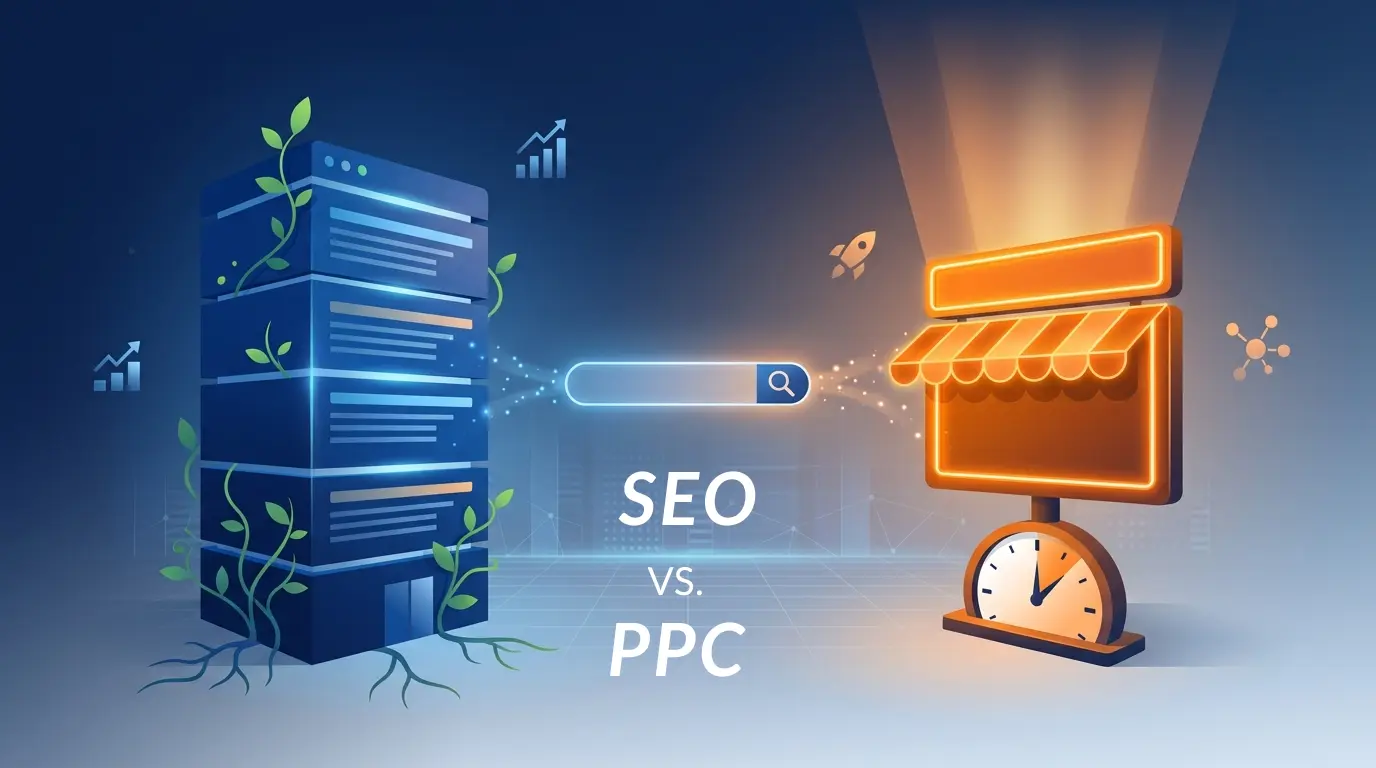
Think of PPC as renting a storefront on the busiest street in town. The moment you stop paying rent, your storefront disappears, no matter how well it performed while it was open.
SEO works more like buying the building. It takes longer to move in, and the upfront work is heavier, but once you own that visibility, it keeps generating customers without a new invoice every month.
This "rent vs own" model sits at the center of every part of digital marketing that touches search, and it explains why long-term SEO investment usually wins once enough time has passed.
The Crossover Point
Every SEO vs PPC comparison eventually reaches a single question. At what point does organic search actually become cheaper than paid ads?
Industry data puts that crossover between month 12 and month 18 for most small businesses. Before that point, PPC often produces cheaper leads because your organic rankings are still building authority. After that point, your SEO cost per lead keeps dropping while your PPC cost per lead stays flat or climbs, and the gap between the two only widens from there.
The Financial Anatomy of Search: ROI, CPL, and the Trust Gap
Once you understand the timeline, the next question is pure math. Organic search vs paid search comes down to how much each channel actually returns for the money you put in, and how much each lead really costs you.
The ROI Disparity
The numbers here are not close. Mature SEO campaigns deliver an average SEO ROI of 748%, according to SEO ROI research, while PPC ROI averages a much lower 36% over the long term. That gap is not a rounding error. It means a mature SEO program returns roughly 20 times more per dollar spent than a paid ad account of the same age, and it is the single clearest way to settle a Google Ads vs Organic SEO debate.
This is also why comparing marketing channels on profitability always puts organic search near the top of the list. Search engines capture people who are already looking to buy, and SEO lets you capture that demand without paying for every single visit.
Cost-Per-Lead (CPL) Benchmarks
The ROI numbers make more sense once you break them into cost per lead. Organic leads average around $14, while PPC leads average around $44.
That gap works out to roughly a 68% cost advantage for businesses that rank organically instead of paying for every click.
| Metric | SEO (Organic) | PPC (Paid) |
| Average cost per lead | $14 | $44 |
| Typical time to first leads | 3 to 6 months | Same day |
| Cost trend over time | Falls as rankings mature | Stays flat or rises |
| Long-term ROI | 748% | 36% |
For a full breakdown of which channels return the most per dollar spent, see our blog on the digital marketing technique that offers the highest ROI.
Industry-Specific "Profitability Killers"
Some industries cannot make PPC work at all without a very high conversion rate or a large customer lifetime value. Legal and financial services are the clearest examples.
In these sectors, cost per click can exceed $130 per lead. Suppose a small law firm spends $3,000 a month on ads at that rate. That budget buys barely 23 leads, and if even a handful fail to convert, the campaign loses money before a single case closes.
The Psychological "Sponsored" Penalty
Paid ads also carry a trust problem that no amount of budget can fix. Roughly 70 to 80% of searchers skip paid ads and click an organic result instead, because they see organic rankings as an earned endorsement rather than a paid placement.
This matters more than most business owners realize. A customer clicking your organic listing already trusts you a little more before they even reach your website, and that trust tends to carry through the rest of the buying journey.
Generative Engine Optimization (GEO): Why AI Search Changes the Debate
The SEO vs PPC conversation used to be simple. In 2026, a third factor changes the math completely: AI search.
Visibility in AI Overviews
Google's AI Overviews and AI chat tools like ChatGPT and Gemini build their answers almost entirely from high-ranking organic content. Paid ads have no real equivalent path into these summaries.
If your competitor gets cited inside an AI Overview and you do not, they win the customer before you even get a chance to bid on the click. No PPC budget, no matter how large, can buy that same spot inside a generated answer.
The Rise of Zero-Click Search
More than 60% of searches now end without a single click, and current 2026 tracking puts the figure closer to 68%, according to zero-click search data. Users get their answer directly on the results page and move on.
This sounds like bad news for SEO, but it actually works in favor of businesses that rank well. Organic content optimized for AI citation still earns brand exposure and authority even when the searcher never visits the site. PPC ads get no version of this benefit, since an ad nobody clicks earns you nothing.
Entity-Based Authority
Ranking in 2026 requires more than matching keywords. Content needs to be built around entities, meaning clear facts, direct answers, and structured data that AI engines can pull out and quote accurately.
This is a deeper shift than most small business owners expect. A page stuffed with keywords but light on real facts will not get cited by an AI Overview, no matter how well it used to rank under older SEO rules.
The "Fail-Safe" Integration Playbook: How to Blend Channels Without Wasting Budget
SEO vs PPC does not have to be a choice between two rivals. The businesses that win in 2026 treat them as two arms of the same search engine marketing strategy, and real SEO and PPC integration means each channel covers the other's weaknesses instead of competing for the same budget.
The $4,200 Mistake
Sending paid traffic to a generic homepage is one of the most common and most expensive mistakes in PPC. Visitors land on a page built for everyone, find nothing specific to their search, and leave without converting.
Suppose a business spends $4,200 a month on ads that all point to the homepage. A dedicated landing page with one clear call to action and visible social proof can drop your Customer Acquisition Cost by more than 95% compared to that same cluttered, generic page. The fix costs a fraction of what the mistake wastes every single month.
Keyword Reciprocity
PPC and SEO can feed each other real data instead of running in separate silos. Your PPC "Search Term Report" shows the exact long-tail phrases that are already converting into paying customers.
Feed those same terms into your long-term SEO content plan, and you remove the guesswork from keyword research entirely. You already know these phrases convert, so building organic content around them is one of the safest content investments you can make.
The "SERP Monopoly" Tactic
Appearing in both the paid ad slot and the top organic result for the same search doubles your presence on that results page. This combination can increase your total click-through rate by up to 40%, while also reinforcing your brand as the clear authority in your niche.
Even searchers who ignore the ad still see your brand name twice before they scroll further down the page. That repetition builds recognition even on searches that do not end in an immediate click.
Bidding on Your Own Brand
Bidding on your own brand name might look wasteful at first glance since you probably already rank first organically for it. In practice, it protects territory competitors are actively trying to take from you.
Rival businesses and directory sites often bid on your brand name to intercept customers who are already searching specifically for you. A small, cheap brand campaign blocks that interception and keeps your own branded search real estate under your control. The cost per click on your own brand terms is usually pennies, because Google rewards high relevance with a lower price.
Experience-Driven Strategy: When to Stop, Scale, or Pivot
Numbers only take you so far. Knowing when to shift budget between SEO and PPC comes down to reading your own results and reacting to them early.
Validation Before Investment
Before committing to a six-month SEO roadmap for a brand-new product or service, run a short PPC test first. Two weeks is usually enough.
Suppose you are launching a new service line and are not sure it will convert at your target price. A two-week PPC test tells you quickly whether the offer itself works before you invest months of SEO content around it. This single step can save an entire quarter of wasted content production, and it pairs well with what any solid digital marketing course teaches about structured campaign testing.
Dynamic Budget Shifting
Once your organic content reaches the top three positions for a keyword, that keyword's PPC spend usually becomes redundant. You are now paying to rank for something you already rank for free.
At that point, pull the PPC budget from those specific keywords and redirect it toward new markets, new product lines, or retargeting campaigns for visitors who did not convert the first time.
This keeps your total marketing budget working at full capacity instead of paying twice for the same search result.
Retargeting the "Trust Tunnel"
Not every visitor converts on the first visit, even from a strong organic ranking. This is where PPC still earns its place inside an SEO-led strategy.
Retargeting ads follow visitors who read your organic content but left before converting, guiding them back through what feels like a trust tunnel built from repeated, familiar exposure.
Because these visitors already trust your brand from the organic content they read, retargeting ads to this audience convert at a noticeably higher rate than cold PPC traffic ever does. This combination captures value your organic content already earned but did not fully close on the first visit.
Final Words
SEO vs PPC was never really a competition. It is a budget allocation problem with a correct answer that changes as your business grows.
Start with PPC if you need leads immediately or your budget is too small to feed SEO properly. Shift weight toward SEO as your rankings build, because the cost per lead keeps falling while your paid costs stay flat.
By month 12 to 18, the numbers almost always favor organic search, and by year two, a well-built organic foundation with a lean PPC layer on top usually beats either channel running alone.
If you want a partner who can build this exact framework around your own budget and industry, working with a proven SEO Company in Bangladesh turns this financial model from theory into a working plan.
Most Common FAQs on SEO vs. PPC in 2026
Is SEO or PPC Better for a New Small Business With a Limited Budget?
For most limited budgets, SEO is the safer starting point because it does not need a minimum ad spend to begin building rankings. PPC only makes sense on a tight budget if you need leads within the next few weeks and can accept a higher cost per lead in exchange for speed.
How Long Does It Actually Take to See a Return on Investment From SEO?
Most small businesses see early ranking movement within two to three months and measurable traffic growth by months four to six. Full ROI, where SEO cost per lead drops below PPC cost per lead, usually shows up between months 12 and 18.
Can Running Google Ads Improve My Organic Search Rankings Directly?
No, Google has confirmed that ad spend does not directly influence organic rankings. What PPC can do indirectly is reveal which keywords convert, which then helps you prioritize the right terms for your organic content strategy.
What Is a Realistic Starting Budget for a Small Business to Test PPC?
Most agencies recommend starting with at least $500 to $1,000 a month for Google Ads, since anything smaller often fails to generate enough clicks for the algorithm to optimize the campaign properly. Local service businesses in competitive industries may need closer to $1,500 to see reliable results.
Why Do My Competitors Always Appear in the "AI Overview" and I Don't?
AI Overviews pull from content that clearly answers a specific question with structured, factual detail, not from pages built primarily around keywords. If your competitor's content is more direct, better organized, and backed by clearer data, the AI system is more likely to select it as a source.
Does the "Sponsored" Tag on Google Ads Reduce Customer Trust?
Yes, multiple studies show a large share of searchers skip sponsored results specifically because they carry a paid label. Organic results are perceived as earned rather than bought, which gives them a built-in trust advantage before a customer even clicks.
When Should I Stop Paying for Ads If I Already Rank on the First Page?
You rarely need to stop entirely, but you should reduce spend on keywords where you already hold a top three organic position. Redirect that saved budget toward new keywords, new markets, or retargeting campaigns instead of paying twice for traffic you already earn for free.
Ruth Carol is a professional SEO expert providing services concerning to search engine optimization process. She has 10 years long experience with vast knowledge in the field of modern search engine optimization process and is continuing. Her educational background, along with her working experience in this field, enables her to gain ample knowledge in this subject area. She was an active volunteer in google serve program and a regular blog writer subjecting SEO optimization process and special tips. Follow her blogs on seoviser. Besides, she is an active member of the Chang Mei International SEO Conference. Furthermore, she is the founder of SEO Viser, which is an SEO agency providing SEO solutions all over the world. She aims to help companies ranging from small to big to develop a long-lasting solution to rank their site. Apart from that, she provides consultancy services related to search engine optimization and contributing to social media and online platforms like Fiverr, Upwork, etc. To know more about her services and anyone can visit seoviser or simply email her through her website. She is a great mind and loves to share knowledge. Contact her at seoviser.
OUR SERVICES


Request a free quote
We offer professional SEO services that help websites increase their organic search score drastically in order to compete for the highest rankings even when it comes to highly competitive keywords.
More from our blog
See all posts