Hyperlocal SEO: How to Rank for Neighborhood and "Near Me" Searches
- August 20, 2026
- Local SEO
Hyperlocal SEO is a highly targeted strategy focused on optimizing a business's online presence to attract customers from a micro-geographic radius, usually within one to five miles of the physical location.
While traditional local SEO targets an entire city or metro area, hyperlocal SEO drills down to specific neighborhoods, towns, ZIP codes, and landmarks. A dentist in Gulshan and a dentist in Mirpur are fighting two completely different search battles, even though Google technically files them under the same metro area.
The surge behind this shift comes from “near me” searches and voice search, where Google increasingly matches a searcher's exact location to the closest relevant business rather than the closest big-name brand. Most local SEO guides stop at the city level and leave that gap wide open.
This blog breaks down what hyperlocal SEO actually covers, how Google decides who shows up for a nearby search, and how to build neighborhood pages that help instead of hurt your rankings.
It also covers something most competing guides skip entirely: how AI tools like ChatGPT and Perplexity pull local business data from a completely different source than Google, and what that means for your visibility.
What Hyperlocal SEO Actually Means
Hyperlocal SEO narrows the target area from a city down to a neighborhood, a cluster of streets, or the radius around a specific landmark. Local SEO gets a plumber found across Dhaka. Hyperlocal SEO gets that same plumber found by someone searching specifically for "plumber near Dhanmondi Lake."
The difference shows up clearly once you compare two searches side by side. "Bakery in Dhaka" pulls up every bakery Google considers relevant across the whole city, and the competition includes every bakery with a strong profile citywide.
"Bakery near Banani 11" narrows the field to a handful of businesses close enough to matter, which means a smaller, less crowded, and often more accurate business finds it easier to rank.
Check more about how these two approaches differ in our full breakdown of SEO vs. Local SEO.
The table below lays out the core differences at a glance, since geographic focus, user intent, and competition level all shift once a search narrows from city-wide to hyperlocal.
| Feature | Local SEO | Hyperlocal SEO |
| Geographic Focus | City, metro area, or county | Neighborhood, street block, or landmark radius |
| Example Keywords | "Plumber in Dhaka" | "Plumber near Dhanmondi Lake" |
| User Intent | Investigation or planned visit | Immediate, high-intent action (walking or short-drive distance) |
| Competition | High, competing with city-wide brands | Low, competing only with immediate neighbors |
The searcher's intent is the real difference. Someone typing a neighborhood or landmark name has already decided they want something close by right now.
That intent is exactly what hyperlocal SEO is built to capture, and it is also why hyperlocal listings tend to dominate local pack rankings for tightly targeted searches while broader city-level competitors get pushed further down.
How Google Decides Who Ranks Nearby
Google's own Business Profile Help documentation states plainly that local rankings are based primarily on three factors: relevance, distance, and prominence. Every hyperlocal tactic in this blog feeds into one of those three.
Relevance measures how well a business profile matches the search itself. Google reads the business category, the services listed, the attributes filled in, and the website content to judge the match.
A locksmith categorized simply as "hardware store" will lose to a competitor correctly categorized as "locksmith," regardless of how good the actual service is.
Distance measures how close the business is to the location in the search, or to the searcher's own location if no place name is included. This factor is not something a business can manipulate.
It can only be improved by being verified at an accurate address or by expanding into more service areas.
Prominence reflects how well known and trusted the business appears to be, based on signals like reviews, citations, and backlinks.
According to the Whitespark 2026 Local Search Ranking Factors survey of 47 local SEO experts, Google Business Profile signals now carry roughly 32 percent of local pack ranking weight, the single heaviest category, with review signals close behind at around 20 percent. That data point alone explains why so much of this blog circles back to the GBP.
Finding Hyperlocal Keywords That Actually Have Demand
Hyperlocal keyword research works differently from standard keyword research because the terms people actually search are more specific and often show zero recorded search volume in keyword tools. That does not mean nobody is searching for them.
Neighborhood and landmark keywords tend to follow a small set of predictable patterns. A searcher combines a service with a neighborhood name ("electrician Uttara"), a service with a landmark ("cafe near Hatirjheel"), or a service with a street ("tailor on Mirpur Road").
Mapping out these combinations for every area a business genuinely serves gives a realistic starting list.
Zero-volume long-tail keywords deserve more attention than most guides give them. A term that shows "0" in a keyword tool because too few people search it every month can still convert extremely well, because the tiny group of people who do search it is usually ready to buy or visit within the hour.
Volume tells you how many people search a term. It says nothing about how close those people are to acting on it.
Free tools like Google Search Console, Google Trends, and the "people also search for" panel on Google Maps surface real neighborhood-level demand at no cost. Paid tools add scale and competitor comparison, but they are not required to get started.
What matters more than the tool is checking off the fundamentals first, which is exactly what our local SEO checklist is built to walk through.
Building Neighborhood Pages That Don't Get Flagged as Thin
Neighborhood landing pages are one of the most effective hyperlocal tools available, but only when each one earns its place. A real neighborhood page needs its own reason to exist.
That means a unique introduction, specific local details such as parking, nearby landmarks, or delivery zones, and content that could not simply be copy-pasted onto a different page with the city name swapped out.
Google's own spam policies for web search call out doorway pages directly, describing them as pages "created to rank for specific, similar search queries" that funnel visitors toward a single destination rather than serving them directly.
The guidelines specifically flag having multiple pages targeted at different regions or cities that all lead back to one generic page. A neighborhood page built by copying a template and changing the area name is exactly the pattern Google is warning against.
Businesses serving several neighborhoods from one location often organize their site with a hub-and-spoke structure, where one central local SEO page links out to individual neighborhood pages.
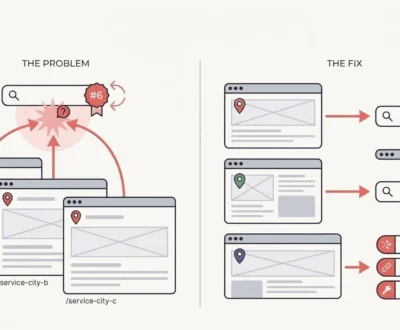
This works well when each spoke page earns its place with real, distinct content. It backfires when two neighborhood pages end up competing against each other for the same search terms, a problem known as cannibalization, which usually happens when the areas are too close together, or the content overlaps too much.
Before adding a new neighborhood page, check whether an existing page could reasonably serve that area instead.
Google Business Profile as Your Strongest Lever
Google Business Profile optimization is the single highest-leverage activity in hyperlocal SEO, and the primary category a business selects is the strongest individual relevance signal inside it.
The Whitespark 2026 data ranks primary category selection, proximity, and keywords in the business title as the top three individual local pack factors, and primary category sits at the top of that list.
Choosing the most specific category available beats choosing a broader, safer-sounding one almost every time.
A business calling itself a "restaurant" when it is really a "biryani restaurant" is leaving a clear relevance signal on the table. Beyond category, a complete profile with accurate service descriptions, current hours, and regularly added photos gives Google more evidence to match the listing against nearby searches.
Our blog on Google Business Profile optimization covers the full setup process step by step.
Local Citations and Links That Carry Real Weight
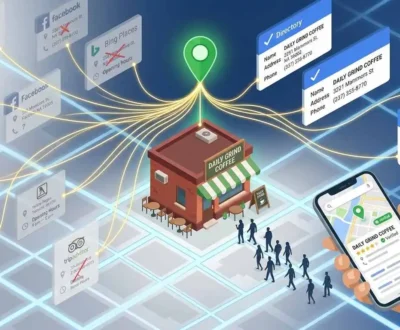
Local citations are any online mention of a business's name, address, and phone number, whether or not it links back to the website. NAP consistency, meaning the same name, address, and phone format across every directory, is what allows Google to confidently confirm a business actually exists at the location it claims.
Inconsistent formatting across listings, even something as small as "St." versus "Street," can quietly weaken the trust signal Google is trying to build.
Backlinks matter for hyperlocal rankings too, but not all backlinks carry equal weight for this purpose. One backlink from a genuinely local source, such as a neighborhood news site, a local business association, or a community blog covering the same area a business serves, does more for hyperlocal prominence than ten generic backlinks from unrelated national sites.
Local relevance in a link matters as much as its authority. For a full walkthrough of where to build these citations correctly, see our blog on local SEO citations.
Showing Up in AI Overviews and AI Answer Tools
AI Overviews now appear in a large and growing share of local search results, and most hyperlocal SEO content written before 2026 does not account for this shift at all.
This is also where most competing guides on this exact topic fall short, because they focus entirely on Google's local pack and ignore how AI tools actually source their answers.
ChatGPT does not read Google Business Profile data directly. It pulls local business information primarily through Bing, which means Bing Places for Business, along with directories like Yelp and other reputable local listings, plays a much bigger role in how ChatGPT and similar tools describe a business than most owners realize.
Perplexity shows its sources openly, and testing those source panels for common searches in your own niche is one of the fastest ways to see exactly what it is pulling from.
A business with a strong Google Business Profile but an unclaimed or outdated Bing Places listing is often invisible to a growing share of AI-driven local search.
What actually helps across both traditional AI Overviews and standalone AI tools is structured, direct-answer content. Pages that state a clear answer early, use accurate schema markup, and keep NAP and service details identical everywhere they appear give these systems consistent, trustworthy information to pull from.
Guesswork and keyword stuffing do not translate well into an AI-generated summary, but a clean, factual answer does!
Final Words
Hyperlocal SEO comes down to matching Google's relevance, distance, and prominence signals as tightly as possible to a specific neighborhood, street, or landmark.
A complete, correctly categorized Google Business Profile carries the most weight. Consistent citations and genuinely local content build the trust layer underneath it. None of this requires guesswork once the fundamentals are in place.
Getting all of these pieces built correctly and kept current takes real ongoing work, especially across multiple neighborhoods or locations.
Working with an established SEO Company in Bangladesh can take that setup off your plate and make sure the technical details, from schema to citation consistency, are handled correctly from day one.
If you would rather start with the basics yourself, our blog on affordable local SEO services is a good next stop!
Most Common FAQs on Hyperlocal SEO
How Long Does Hyperlocal SEO Take to Show Results?
Some movement usually shows up within four to eight weeks, especially from quick Google Business Profile fixes like correcting the primary category or filling in missing service details.
Deeper, more durable ranking gains from citations, on-page content, and local links typically take three to six months to fully take hold. Competitive neighborhoods with several established businesses already ranking will naturally take longer than quieter areas.
Do I Need a Separate Page for Every Neighborhood I Serve?
No, not for every single one. A separate page only makes sense when a neighborhood has real search demand and enough unique local detail to justify its own content, since thin pages built by swapping out a city name risk being flagged under Google's doorway page guidelines.
Group smaller or overlapping areas under one broader page instead of forcing a template page for each one.
How Is Hyperlocal SEO Different From Regular Local SEO?
Local SEO typically targets an entire city or metro area, while hyperlocal SEO narrows that target down to a specific neighborhood, a cluster of streets, or the area around a landmark.
The competition is usually smaller at the hyperlocal level, but the searcher's intent to visit or buy immediately tends to be much higher.
What Schema Markup Actually Matters Here?
LocalBusiness schema, or a more specific subtype that matches the actual business, should include the name, address, phone number, geographic coordinates, hours, and service area exactly as they appear on the page.
FAQPage schema is also worth adding to any FAQ section, since it gives search engines and AI tools a clean, structured version of the same answers already on the page.
The schema should always match the visible content exactly, since mismatched or inflated schema data goes against Google's own guidelines.
Can a Service-Area Business Rank Hyperlocally Without a Storefront?
Yes. Google Business Profile supports service-area businesses that hide their exact address, as long as the service area is set accurately and the category and service details are filled in completely.
Pair that with area-specific content and citations from directories that accept listings without a public storefront address, and a service-area business can rank hyperlocally just as effectively as one with a physical location.
Ruth Carol is a professional SEO expert providing services concerning to search engine optimization process. She has 10 years long experience with vast knowledge in the field of modern search engine optimization process and is continuing. Her educational background, along with her working experience in this field, enables her to gain ample knowledge in this subject area. She was an active volunteer in google serve program and a regular blog writer subjecting SEO optimization process and special tips. Follow her blogs on seoviser. Besides, she is an active member of the Chang Mei International SEO Conference. Furthermore, she is the founder of SEO Viser, which is an SEO agency providing SEO solutions all over the world. She aims to help companies ranging from small to big to develop a long-lasting solution to rank their site. Apart from that, she provides consultancy services related to search engine optimization and contributing to social media and online platforms like Fiverr, Upwork, etc. To know more about her services and anyone can visit seoviser or simply email her through her website. She is a great mind and loves to share knowledge. Contact her at seoviser.
OUR SERVICES


Request a free quote
We offer professional SEO services that help websites increase their organic search score drastically in order to compete for the highest rankings even when it comes to highly competitive keywords.
More from our blog
See all posts