Most SEO advice treats backlinks and referring domains as the same thing.
They are not, and mixing them up can waste months of link-building effort. A backlink is a single link pointing to your site.
A referring domain is the unique website sending that link, no matter how many times it links to you.
This distinction matters because raw link counts can hide a weak strategy. A top-rated SEO agency knows that ten links from one site rarely move rankings the way one link from ten different sites does.
By the end of this guide, you will know exactly which metric to chase and how to grow it the right way.
What is a Backlink?
A backlink is a hyperlink from one website to another. Think of it as a digital reference, much like a citation in a research paper.
Backlinks help search engines find your pages, understand your topic, and judge your credibility.
A strong backlink can also send real visitors straight to your site, so it works for both rankings and traffic at once.
Not every backlink carries the same weight.
A link from a trusted, relevant site usually means more than one from a weak or unrelated source, especially when it sits naturally inside content people actually read.
What is a Referring Domain?
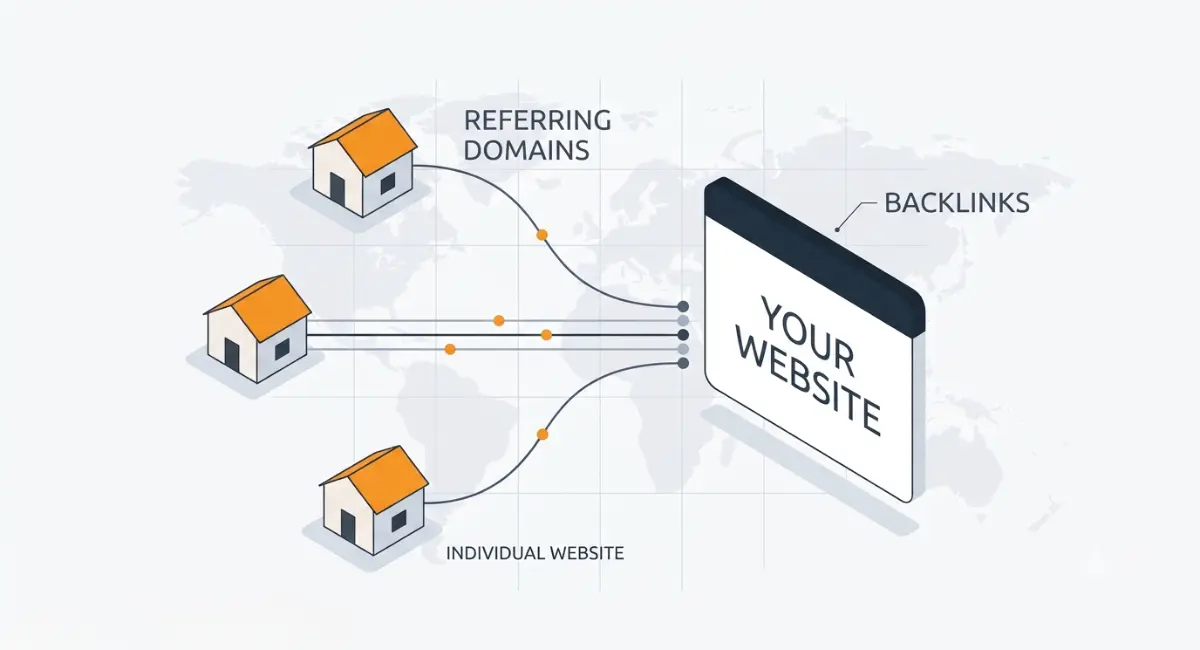
A referring domain is the unique website sending one or more backlinks your way. If one site links to you ten times, that is still one referring domain, even though it adds up to ten backlinks.
This is why referring domains often matter more than people assume. SEO tools and search engines lean on referring domain counts to show how widely a site gets referenced across the web. More unique referring domains usually point to a broader reputation and a healthier link profile.
That does not make every referring domain valuable by default. The best ones are relevant to your niche, trustworthy on their own, and capable of sending real traffic, not just padding a metrics dashboard.
Quick Tip: When auditing your link profile, sort by referring domains first. A high backlink count from a handful of sites tells you far less than a smaller count spread across many sources.
The "House and Guest" Analogy
Picture your website as a house.
A backlink is one guest walking through the front door. A referring domain is the house that invited them. If that same house sends ten guests, you still have just one referring domain, but ten backlinks.
This picture explains why both numbers matter, just differently. More backlinks can mean more chances for discovery. More referring domains usually means more independent sources have noticed you.
It also explains why diversity counts. If only one or two sites keep linking to you, your profile looks narrow. If many different sites cite your content, your site looks established and widely trusted.
Backlinks vs. Referring Domains: Key Differences at a Glance
Backlinks vs. Referring Domains comes down to volume versus diversity. Backlinks count the links themselves.
Referring domains count the unique websites sending them. Both numbers tell a different part of the same story.
| Aspect | Backlinks | Referring Domains |
| What it measures | Individual links pointing to a page or site | Unique websites sending those links |
| Best use | Measuring link volume and page exposure | Measuring source diversity and authority spread |
| Example | One site linking to you five times = five backlinks | The same example still equals one referring domain |
| SEO value | Helpful, especially when links are relevant and editorial | Often a stronger indicator of broad trust and recognition |
Backlinks are the pieces. Referring domains are the sources.
A healthy SEO strategy grows both, but it prioritizes unique, relevant sources over repeating the same link everywhere.
Quantity vs. Diversity
A large backlink count can look impressive on a report, but it can mislead you if those links all trace back to a handful of sites.
Diversity is what makes a site look naturally cited across different corners of the web.
Ten backlinks from one domain do less for your unique referring domains count than one backlink from ten different domains.
That is why SEO professionals weigh unique referring domains heavily, often more than total backlink count.
This is also where quality comes in. A few strong referring domains from trusted, relevant sites can outperform a stack of low-value links from weak or unrelated ones.
The Functional Relationship
Backlinks and referring domains work together, but they play different roles. Backlinks are the signals. Referring domains are the channels delivering those signals.
Think of backlinks as votes and referring domains as voters. A site with many votes from many different people looks more credible than one with many votes from a single source repeated again and again.
That relationship matters for rankings, discovery, and trust. When your content earns links from multiple independent sites, search engines read that pattern as proof the page is genuinely useful.
Authority vs. Relevancy
Authority and relevancy overlap, but they are not interchangeable.
A powerful domain can pass strong signals, yet if it sits completely outside your niche, the link may do less than one from a smaller site that matches your topic exactly.
This is where a lot of link building goes wrong. People chase high metrics and forget audience fit, even though a relevant site is more likely to send qualified clicks and reinforce topical trust.
The ideal link combines both. A link from a respected domain inside your industry checks every box: trust, relevance, and real user value, all in one placement.

Why Referring Domains are the True Drivers of Organic Traffic
Referring domains tend to correlate more closely with organic growth than raw backlink totals, because they reflect how broadly your site has been recognized.
Put simply, more unique sources usually mean more chances for search engines and real readers to find you.
A single website can send you dozens of backlinks without expanding your reach at all.
Several unique referring domains, on the other hand, expose your content to different audiences, drive new referral visits, and strengthen your link profile in a way one repeated source never can.
This is exactly why growing referring domains should sit near the top of any SEO roadmap.
It signals that your content is valuable enough for different publishers, bloggers, and editors to reference it independently of each other.
The Unique Domain Correlation
There is a practical reason SEO specialists obsess over unique domains: one domain can only prove so much. When many different domains point to the same page, that page looks less isolated and far more validated.
That pattern tends to track with organic traffic growth too. The more distinct sites mention your content, the more likely search engines treat your page as a trusted answer within its topic.
This matters even more in competitive industries.
In crowded niches, unique referring domains often separate a site with genuine authority from one that simply recycled the same few links.
Domain Rating (DR) and Trust
Many SEOs lean on Domain Rating or similar third-party scores to estimate a site's strength, but these are not official Google ranking factors.
They are still useful as a quick filter for whether a referring domain is strong, active, and worth pursuing.
Trust matters just as much as the score.
A link from a site that gets cited consistently, stays well maintained, and fits your topic is usually worth more than a link from a random or low-quality source with a high number attached to it.
Important: Good link building is not about collecting links for their own sake. It is about building a credible pattern of endorsements from sites that both people and search engines trust.
The Zero-Traffic Trap
A referring domain can look strong on paper and still be weak in practice if it has little real audience behind it. This is the zero-traffic trap.
The link exists, the metric improves, but the site sends no meaningful visitors or engagement.
That does not mean every low-traffic site is worthless, but traffic should factor into how you evaluate a link opportunity.
If a site has no readership, no topical authority, and no editorial standards, the link may do little beyond adding a number to your backlink report.
The strongest links come from pages real people actually read, click, and trust. That is where SEO value and audience value line up most clearly.
The Power of Contextual Links: Why Where You Link Matters
Where a link sits matters almost as much as whether it exists at all.
A contextual backlink placed inside relevant content usually carries more weight than one buried in a footer, sidebar, or template area that has nothing to do with the topic.
Why? Contextual links are more likely to be editorially earned and genuinely useful to the reader. They fit the surrounding topic, support the article, and read like part of the content instead of a mechanical insertion.
This also lines up with how modern SEO actually works. Search engines look for natural patterns of relevance, not just the bare existence of a hyperlink somewhere on a page.
Contextual vs. Sitewide Links
Contextual links sit inside the body of an article. Sitewide links appear across many or all pages on a site, usually in headers, footers, or sidebars.
Sitewide links can stack up backlinks fast, but they rarely carry strong topical value.
Contextual link building wins out because these links are easier to read as genuine editorial endorsements.
They sit in a paragraph that explains the topic and justifies why the link belongs exactly where it does.
In practice, a handful of strong contextual links usually outperforms a much larger pile of weak sitewide placements.
That makes context one of the sharpest quality filters in link building today, which is why it ties directly into building a smart anchor text strategy for your overall profile.
Editorial Standards
Editorial standards separate earned links from forced ones.
A genuine editorial link gets placed because the content actually helps the reader, not because a site owner is stuffing in links to manipulate rankings.
This is why outreach, guest posting, and digital PR perform best when the underlying content is genuinely useful.
If a publisher would reasonably choose to include the link on their own, that link is healthier from an SEO standpoint.
Strong editorial standards protect your brand too. When your links show up inside quality content, your business comes across as more credible and easier to trust at first glance.
Credibility and User Experience
A good contextual link should improve the reader's path through the content, not interrupt it.
If the link adds clarity, evidence, or a useful next step, it builds both credibility and a better user experience at the same time.
That matters because SEO was never only about pleasing search engines. A link that real users click and find genuinely helpful builds brand awareness, engagement, and trust that compounds over time.
Heads Up: Page performance plays into this too. If the destination page loads slowly, even a strong backlink can lose its value, because visitors may leave before they ever engage with the content.
Experience-Based Insights: Avoiding Common Backlink Pitfalls
After reviewing hundreds of link profiles, the pattern is clear: most backlink strategies fail not because links are useless, but because the execution is careless.
People chase shortcuts, ignore relevance, and chase metrics instead of outcomes.
A better approach treats every link decision like a publisher and a user would. Ask whether the link feels natural to a real reader, whether it fits the topic, and whether the destination page actually deserves the click it's getting.
That mindset consistently produces fewer but better links.
Over time, those links tend to stay stable, deliver real value, and align with long-term SEO growth instead of short-term metric spikes.
The Anchor Text Trap
Anchor text is the clickable text inside a link, and it needs careful handling.
If every backlink uses the exact same keyword phrase, your profile starts looking unnatural fast.
You can avoid this over-optimization by following our comprehensive guide on anchor text best practices.
A healthier profile mixes branded anchors, naked URLs, partial matches, and descriptive phrases that vary naturally from link to link. This variation makes the profile look organic and lowers the risk of over-optimization penalties.
Warning: The goal is clarity, not repetition. Good anchor text should tell the reader what they will find on the other side of the click, without sounding forced or keyword-stuffed.
Load Time vs. Link Value
A link can bring real authority, but the landing page still has to perform. If that page loads slowly or feels poorly built, visitors may bounce before the link ever delivers its benefit.
This is exactly why technical SEO and link building need to work together, not separately. A fast, well-structured landing page is what turns link authority into actual ranking and conversion gains.
Think of it this way: a good backlink is the invitation, but a fast page is the welcome mat. If the page experience falls flat, the invitation loses most of its impact.
The Inbound Penalty Myth
One persistent myth claims that any inbound link can hurt your site.
In reality, the danger comes from manipulative, irrelevant, or low-quality linking patterns, not from backlinks as a category.
For example, instead of issuing manual penalties for old-school link swaps, Google now discounts all reciprocal links that lack genuine editorial value.
High-quality backlinks remain a normal, important part of SEO. The real goal is earning links in a way that genuinely helps humans and makes sense to search engines at the same time.
So the right question is never "do backlinks cause penalties." It is "are these links natural, relevant, and trustworthy?"
7 Proven Ways to Acquire High-Quality Referring Domains
If you want referring domains that actually move organic growth, the strategy has to focus on earning attention, not just placing links wherever you can.
The strongest methods combine content quality, real outreach, and topical relevance.
An SEO Agency builds this kind of approach into its backlink and monthly SEO positioning, because it already prioritizes high-quality backlinks, niche relevance, and durable ranking support.
The seven methods below are practical, tested ways to grow unique referring domains over time.
Guestographics
Guestographics use original visuals, charts, or data-driven graphics that other sites genuinely want to cite or embed.
They work because they deliver immediate value and give publishers something easy to reference inside their own content.
The key is usefulness. If your graphic solves a real problem, summarizes useful data clearly, or simplifies a complex topic, it becomes a natural link magnet on its own.
This method performs especially well in educational and B2B niches, where editors regularly need visuals that strengthen the articles they're already writing.
The Broken Link Pivot
Broken link building helps publishers fix dead references on their own site while giving you a real shot at a relevant backlink.
You find a broken resource on a page, then suggest your content as a useful replacement.
This works best when your page sits close to the original topic and offers equal or better value than what was lost. The more genuinely helpful your replacement, the easier it is for the editor to say yes.
It is a classic win-win tactic. You help improve the publisher's content quality while earning a new referring domain in the same move.
Newsworthy Content
Newsworthy content earns links because it gives people something timely, original, or quotable.
This includes original research, surveys, industry commentary, case studies, or fresh data sets nobody else has published.
The sharper your angle, the easier it becomes to attract citations from blogs, newsletters, journalists, and niche publishers. Strong newsworthy content often earns links naturally, simply because others want to reference where the information came from.
Pro Tip: Make the content easy to reuse. Clear charts, concise findings, and sharp takeaways all raise the odds that other sites will cite your work directly.
Strategic Guest Posting
Guest posting still works, but only when it's done with quality and relevance in mind.
The strongest guest posts are not link dumps. They are genuinely strong articles built for the host site's audience and editorial style.
Strategic guest posting helps you earn referring domains, build authority, and introduce your brand to new readers who already trust the publication.
But it needs to stay selective, not mass-produced, or the value drops fast.
The ideal guest post solves a real problem, educates the audience, and includes a link only where it genuinely helps the reader, not where it's most convenient for you.
Podcast Networking
Podcasts are an underrated way to earn referring domains, since most shows publish guest pages, show notes, or episode summaries that include links back to guests.
They also put your brand in front of an engaged audience that already trusts the host.
Podcast networking performs best when you bring a useful perspective, case study, or story to the table. The more specific and actionable your insight, the more likely hosts are to feature and link to you in their notes.
This method also widens your link profile beyond blog content alone, which tends to make your overall backlink growth look more natural and diverse.
Resource Pages and Lists
Resource pages exist specifically to point readers toward useful tools, guides, and references.
If your content genuinely fits the topic, landing a spot on a curated list can be a reliable way to gain a high-quality referring domain.
This tactic works best when your page is useful, current, and clearly stronger than the alternatives already listed. Editors generally want to link to content that saves their audience time, not content that wastes it.
A clean, well-structured article with solid on-page SEO improves your odds here.
This includes foundational technical setups, such as choosing the right approach between absolute vs. relative link structuring for your internal architecture.
Digital PR and Expert Quotes
Digital PR earns links by giving publishers something they actually need: expert commentary, original insight, or data worth citing. Expert quote campaigns can place your brand inside articles that already carry built-in visibility and authority.
This method works well because it runs on relationships and content quality at the same time. If your insight is genuinely useful, journalists and editors are far more likely to cite you as a credible source.
Over time, these citations build a strong referring domain profile that supports trust and traffic together, rather than chasing one at the expense of the other.
Closing Perspective
Backlinks and referring domains are connected, but they are not the same metric.
Backlinks measure the links themselves. Referring domains show how many unique websites are actually vouching for your content.
If you want sustainable SEO growth, focus on earning links from relevant, trusted, and diverse sources rather than chasing volume from the same few sites.
That approach matches both what modern search engines reward and what a results-driven SEO partner should deliver for you.
In practice, the strategy is simple. Create something genuinely useful, make it easy to cite, and build relationships with the kinds of sites your audience already trusts. The links will follow the value, not the other way around.
Common Backlink Questions, Solved
What is a referring domain's backlink?
A referring domain's backlink is simply the link that a specific unique website sends to your site, however many times it links to you.
Which is better for your website: backlinks or high-quality content?
Quality content always wins, because it's what earns the high-quality backlinks in the first place, not the other way around.
How do backlinks specifically help with SEO rankings?
Backlinks help rankings by signaling trust and relevance to search engines while passing authority from one site to another.
Is it possible for inbound links to hurt my website's ranking?
Yes, but only when links are spammy, irrelevant, or manipulative, not simply because they exist.
What is the difference between formal and contextual links?
Formal links sit in structured areas like footers or directories, while contextual links sit naturally inside relevant body content.
How many types of backlinks are there, and do they all pass value?
There are several types, including editorial, guest post, resource, niche edit, and directory backlinks, but they don't all pass equal value, relevance and placement decide that.
Ruth Carol is a professional SEO expert providing services concerning to search engine optimization process. She has 10 years long experience with vast knowledge in the field of modern search engine optimization process and is continuing. Her educational background, along with her working experience in this field, enables her to gain ample knowledge in this subject area. She was an active volunteer in google serve program and a regular blog writer subjecting SEO optimization process and special tips. Follow her blogs on seoviser. Besides, she is an active member of the Chang Mei International SEO Conference. Furthermore, she is the founder of SEO Viser, which is an SEO agency providing SEO solutions all over the world. She aims to help companies ranging from small to big to develop a long-lasting solution to rank their site. Apart from that, she provides consultancy services related to search engine optimization and contributing to social media and online platforms like Fiverr, Upwork, etc. To know more about her services and anyone can visit seoviser or simply email her through her website. She is a great mind and loves to share knowledge. Contact her at seoviser.
OUR SERVICES


Request a free quote
We offer professional SEO services that help websites increase their organic search score drastically in order to compete for the highest rankings even when it comes to highly competitive keywords.
More from our blog
See all posts